Licensed C-10 electricians installing standby generators from Claremont to Devore. We size the unit, pull the permit with your city or San Bernardino County and wire the automatic transfer switch, so your home stays powered through SCE shutoffs.

Licensed Electrical Contractor

On-Site Estimates

Generac Dealer

West to east along the 210, then north up the 15 into the Cajon Pass. Every stop shares the same wind and shutoff risk. Each one has its own permit office.
The corridor runs along the base of the San Gabriel Mountains, follows the 210 east across the Inland Empire, then climbs into the Cajon Pass at Devore. Eight communities share the same outage risks: Santa Ana winds, SCE Public Safety Power Shutoffs and summer heat that keeps air conditioners running late into the night.
They do not share a permit office. Claremont sits in Los Angeles County. Upland, Montclair, Rancho Cucamonga, Fontana, Rialto and San Bernardino each run their own building departments, and Devore falls under San Bernardino County. This page covers what the corridor has in common and how permits work in each city. For the full service overview, see our backup generator installation page. For local detail, start with generator installation in Claremont or generator installation in Montclair.

Every corridor install, Claremont to Devore, includes a listed automatic transfer switch matched to your panel. It keeps the house off the SCE line while the generator runs.

C-10 license #1133193, insured. We file with all eight corridor permit offices, from Claremont City Hall to San Bernardino County for Devore.

A written estimate, permit filing with your city or the County, and a full walkthrough of your system before we leave.

Outages along the corridor trace back to two causes. Both peak from fall into winter, when dry offshore winds pour out of the canyons and through the Cajon Pass.

Public Safety Power Shutoffs
SCE calls a Public Safety Power Shutoff when high winds and dry vegetation raise the risk of its lines starting a fire. Many foothill neighborhoods north of the 210, plus Devore and the Cajon Pass, sit in or near CAL FIRE Fire Hazard Severity Zones, so their circuits land on SCE’s watch list during wind events. Power stays off until the wind drops and crews inspect the lines. Our SCE PSPS guide explains how the program works.

Wind & Tree Damage
Santa Ana gusts funnel through the Cajon Pass and hit Devore, north San Bernardino, Rialto and Fontana first, then spread west along the foothills. Downed limbs, blown debris and damaged poles cause unplanned outages that come with no notice at all.

Weather modeling starts
SCE forecasters begin tracking a possible fire weather event and the foothill circuits in its path.

Initial notification
When forecasts allow, SCE aims to send the first alert to customers on circuits in scope about three days ahead. Timing varies by event. Look up your own address on the SCE outage map, since every city along the corridor is served by many circuits.

Shutoff expected
SCE sends this notice when possible as a shutoff becomes imminent. Some events come with little or no advance notice. Our SCE Public Safety Power Shutoff guide walks through each alert.

Line inspection
After the weather clears, crews inspect the de-energized lines before restoring power. SCE says inspections typically take up to eight hours. The figure is typical, not a guaranteed restoration time.
Advance notice, when SCE is able to send one, gives you time to plan. No notice keeps a refrigerator cold, a furnace blower turning or a home office online. A standby generator is built for those hours.
Pelican Coast Electric is an authorized Generac dealer. Most corridor homes take an air-cooled Generac unit. Larger properties in the hills above Claremont, Upland and Rancho Cucamonga sometimes need a liquid-cooled model. See the lineup on our Generac home generator page.
Corridor installs also account for wind. Gusts through the Cajon Pass and down the canyons carry dust and debris, so we set the pad where the air intake stays clear and follow the manufacturer clearances plus any fire-zone vegetation rules for your parcel.
We install Kohler standby generators too. Both brands make dependable residential equipment, and both offer natural gas and propane models for foothill properties with or without SoCalGas service. Our Generac vs Kohler comparison covers the differences in detail.


Two questions settle the choice. How much of the house do you want powered, and will someone be home to start the generator? Wind events and shutoffs often arrive overnight or while you are away, which is why automatic standby is our most requested system.
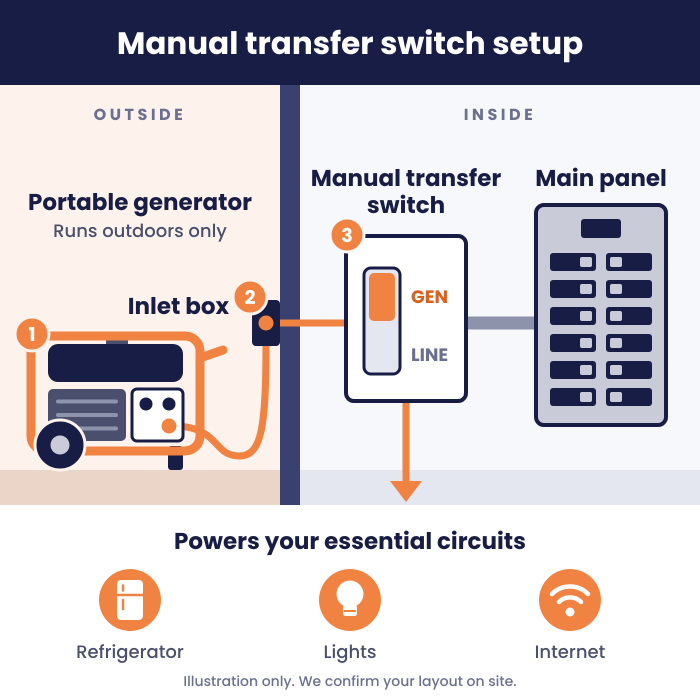
The budget route for a short list of essential circuits. We install a generator inlet and a manual transfer switch at your panel. During an outage you wheel out your portable unit, plug in, start the engine and flip the switch. This setup works when someone is home and able to run it. It offers nothing when the house is empty.
Portable generator safety: the U.S. Consumer Product Safety Commission says to run a portable generator outdoors only, never inside a home or garage, even with doors or windows open. Place the unit at least 20 feet from the house with the exhaust pointed away from the home, and keep working carbon monoxide alarms inside. These rules apply to portable units. A permanently installed standby generator follows the manufacturer’s placement clearances instead.

A permanently installed unit which starts without you. The automatic transfer switch senses the loss of utility voltage, starts the generator and moves your protected circuits to backup power within seconds. When SCE restores the line, the switch transfers back and the generator shuts down. A natural gas unit runs off your SoCalGas service, so a shutoff lasting more than a day does not mean a trip for fuel.
We install standby systems for homes from Claremont to Devore and for businesses along Foothill Boulevard and the commercial districts off the 210 and the 15. Most residential units fall between 14kW and 26kW. Commercial systems are sized from a full load study.


A standby unit backs up the entire house or a selected group of circuits. The answer depends on unit size and how much load management you accept. Your estimate lists both versions with a price for each.
Pelican Coast Electric is an authorized Generac dealer serving the foothill cities from Claremont east to Devore. We hold California C-10 contractor license #1133193. Each installation covers the electrical work, the gas connection and the permit under one written scope.
Four steps take your project from the first site visit to a tested, inspected generator, in any city along the corridor.

Site Visit & Load Calculation
A licensed electrician checks your service size, panel, gas meter and yard clearances, then calculates your load. You receive the proposed pad location and a fixed written price.

Permits & Gas Coordination
We submit the application to your permit office: the city building department, or San Bernardino County Land Use Services for Devore. When the generator needs more gas than your current meter delivers, we file the SoCalGas request at the same time.

Installation
Our crew sets the pad, anchors the generator, installs the transfer switch at your service and runs the gas line with a pressure test. Most homes take one to two days on site.

Inspection, Testing & Maintenance Setup
We meet the city inspector, test the system under load and show you the controller and the weekly self-test. Before leaving, we set your first maintenance visit.
⚡ Typical timeline: 1 to 2 days on site for most homes. Plan review time varies by city, and equipment lead time adds to the calendar.
Every standby generator along the corridor needs a permit. The electrical work, the gas line and the generator placement all get reviewed, and an inspector signs off before the system goes live. What changes from city to city is who reviews the job, how you apply and what the plans must show. We prepare the application and pull the permit under CA License #1133193 in every city below.
The Claremont Building Division at City Hall, 207 Harvard Avenue, issues the permits. The city requires a building permit for electrical work, including any new circuit, and for plumbing work, which covers the gas line.
The City of Upland Building and Safety Division at 460 N. Euclid Avenue takes every permit application online through its Citizen Self Service portal. The public counter is closed on Fridays.
The City of Montclair Building Division issues the permit. The counter keeps limited hours Monday through Thursday, the city is closed on Fridays, and inspections are requested by phone the business day before.
Rancho Cucamonga Building and Safety Services takes applications through the city’s Online Permit Center. We submit the electrical and gas plans there and book the inspection once the permit issues.
Fontana publishes a Residential Standby Generator Plan Submittal checklist: site plan, electrical and plumbing plans, and the manufacturer’s installation instructions. Generators cannot sit in side-yard setbacks or easements, exhaust outlets must stay at least 10 feet from property lines and building openings, and Planning and Fire clearances come before the building permit.
The City of Rialto Building and Safety Division reviews generator installations. Plan on electrical and gas plan review before the permit issues, then a final inspection on site before the system goes into service.
Homes inside city limits, including the north end near the 215, permit through the City of San Bernardino Building and Safety Division. Some nearby addresses sit on unincorporated County land, so we confirm the jurisdiction for your parcel before we file.
Devore has no city government. Permits go through San Bernardino County Land Use Services, Building and Safety, on the County’s EZ Online Permitting portal, where generator installation files as an electrical permit.
Answers to the questions foothill homeowners raise before scheduling an estimate.
A whole-home standby installation typically runs $7,300 to $10,500 on a standard scope, and larger units, long gas runs or panel work cost more. The generator accounts for roughly half the total. The rest covers the automatic transfer switch, the pad, the gas line, the electrical work, the permit and load testing. See our whole house generator cost guide for the breakdown, and book an on-site visit for your fixed price.
We use the term for the foothill communities from Claremont east to Devore: Claremont, Upland, Montclair, Rancho Cucamonga, Fontana, Rialto, the north end of San Bernardino and Devore. We install standby generators across that whole stretch.
Yes. Every city along the corridor requires a permit for a standby generator, covering the electrical connection and the gas line. Claremont permits through its Building Division, each Inland Empire city through its own building department, and Devore through San Bernardino County Land Use Services. We prepare the application, pull the permit under license #1133193 and meet the inspector.
Plan on one to two days of on-site work for most homes. The full schedule also includes plan review, which varies by city, equipment lead time for your unit size and a SoCalGas meter change when the load requires one.
Yes. A standby system responds to a PSPS the same way it responds to any outage. The transfer switch senses the loss of utility power, starts the generator and moves your protected circuits over within seconds. SCE states shutoffs can last more than 24 hours. A properly sized natural-gas standby generator can power the protected circuits during a PSPS while gas service remains available, subject to the manufacturer’s operating and maintenance requirements.
Most homes along the corridor run the generator on natural gas from the existing SoCalGas service. Properties without natural gas service run a standby unit on propane from an on-site tank. We size the gas line or tank connection for the generator at full load.
Size comes from a load calculation, not square footage. Air conditioning drives most of the number here, since inland summers run hotter than the coast. Most homes land between 14kW and 26kW. Our generator sizing guide walks through the math.
Follow the schedule in your generator’s owner’s manual, which sets service by run hours and time. For most homes that means one service visit a year, booked before wind season, with an extra check after a long outage. Our generator maintenance guide lists what each visit covers.
Our installations follow the National Electrical Code, the California Electrical Code and the requirements of your city or San Bernardino County. A generator connected without a listed transfer switch sends power back onto the utility line and puts SCE line crews at risk. Learn more about transfer switch installation.

The transfer switch isolates your home from SCE lines while the generator runs, protecting the crews who restore foothill circuits after a shutoff. Every system is grounded and bonded to code.

Built to the National Electrical Code and the California Electrical Code, then inspected by your city or San Bernardino County.

C-10 license #1133193. Whether your permit came from Claremont, a San Bernardino County city or the County for Devore, you get the permit record, inspection sign-off and system documentation at closeout.
We install standby generators across the foothills from Claremont to Devore. Pick your city for local detail, or call (949) 989-4404 for a free on-site estimate anywhere along the corridor.
Google reviews for Pelican Coast Electric, shown live from our Google Business Profile.
Get your home ready before the next wind event, anywhere from Claremont to Devore. A licensed electrician visits your property, calculates your load and gives you a fixed written price.
Request a quote for generator installation at your home along the foothill corridor. Tell us your city and what you want backed up.