Pelican Coast Electric installs standby generators for Claremont homes. Our licensed C-10 electricians run the load calculation, file with the Claremont Building Division, set the pad, wire the automatic transfer switch and connect the gas line. When Southern California Edison opens your circuit during a foothill wind event, the generator starts on its own and carries your protected circuits within seconds. Free on-site estimates across 91711.

Licensed Electrical Contractor

On-Site Estimates

Generac Dealer

Claremont backs up to the San Gabriel Mountains. North of Base Line Road the streets climb toward Claraboya, Padua Hills and Mt. Baldy Road, and the City of Claremont notes portions of the northern city sit inside mapped fire hazard zones. Fire weather here means strong wind, dry brush and low humidity along the mountain front. For a Claremont homeowner, a wildfire shutoff warning is a local event.
Southern California Edison shuts off circuits, not zip codes. About one-quarter of the SCE service area is a high fire risk area, and SCE says customers near those areas lose power too when their lines run through or near them. A house by the Village, a few miles from the brush, shares the outage when its circuit reaches the foothills. Claremont is also the western end of our foothill generator corridor, which follows the mountain front east to Devore.

Each standby install includes a listed automatic transfer switch sized to your service, so your home stays isolated from the SCE line while the generator runs.

California C-10 contractor, license #1133193, insured. Licensed electricians install the generator and the transfer switch.

A written estimate, permit filing with the City of Claremont, and a full walkthrough of your system before we leave.

Claremont outages trace back to two causes. Both arrive with the wind, and a standby generator responds to both the same way.

Public Safety Power Shutoffs
SCE calls a Public Safety Power Shutoff when strong winds, dry vegetation and low humidity are forecast together. The decision is made per circuit. Circuits reaching the brush above Base Line Road are the ones in scope, and every customer on those circuits loses power together, wherever the house sits. SCE states a shutoff may last over 24 hours.

Wind & Tree Damage
Mature street trees stand alongside overhead power lines across Claremont. On January 21, 2022, a windstorm with gusts reaching 80 miles per hour brought down hundreds of trees in the city. Nearly 20 percent of residents lost power on the first night, as many as 1,400 homes were still out the next morning, and some stayed dark into Monday. No shutoff notice comes before an outage like this one.

Weather modeling starts
SCE forecasters begin tracking a possible fire weather event and the foothill circuits in its path.

Initial notification
When forecasts allow, SCE aims to send the first alert to customers on circuits in scope about three days ahead. Timing varies by event. Look up your own address on the SCE outage map, since Claremont is served by more than one circuit.

Shutoff expected
SCE sends this notice when possible as a shutoff becomes imminent. Some events come with little or no advance notice. Our SCE Public Safety Power Shutoff guide walks through each alert.

Line inspection
After the weather clears, crews inspect the de-energized lines before restoring power. SCE says inspections typically take up to eight hours. The figure is typical, not a guaranteed restoration time.
Advance notice, when SCE is able to send one, gives you time to plan. No notice keeps a refrigerator cold, a furnace blower turning or a home office online. A standby generator is built for those hours.
Pelican Coast Electric is an authorized Generac dealer. Most Claremont homes take an air-cooled Generac unit, and larger foothill properties sometimes need a liquid-cooled model. See the lineup on our Generac home generator page.
We install Kohler standby generators too. Both brands make dependable residential equipment. Correct sizing, a clean installation and regular service matter more to long-term performance than the name on the cabinet. Our Generac vs Kohler comparison covers the differences in detail.


Two questions settle the choice. How much of the house do you want powered, and will someone be home to start the generator? Wind events and shutoffs often arrive overnight or while you are away, which is why automatic standby is our most requested system.
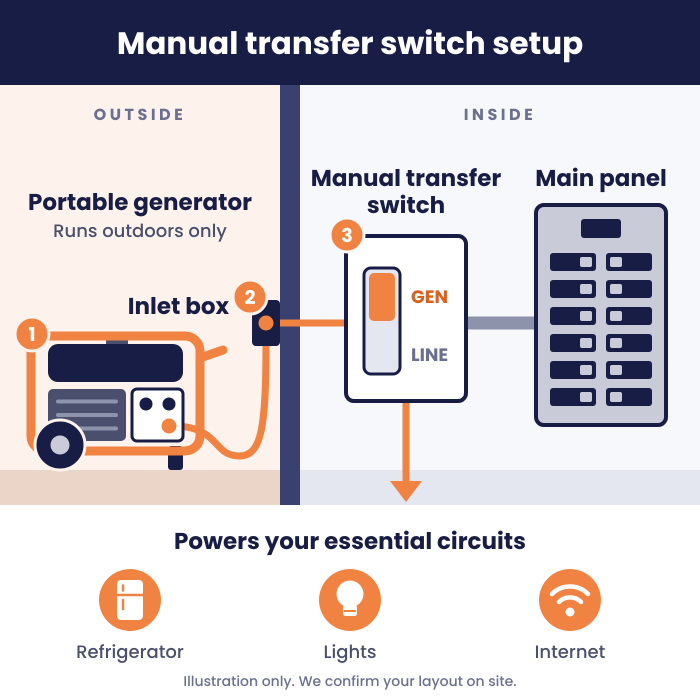
The budget route for a short list of essential circuits. We install a generator inlet and a manual transfer switch at your panel. During an outage you wheel out your portable unit, plug in, start the engine and flip the switch. This setup works when someone is home and able to run it. It offers nothing when the house is empty.
Portable generator safety: the U.S. Consumer Product Safety Commission says to run a portable generator outdoors only, never inside a home or garage, even with doors or windows open. Place the unit at least 20 feet from the house with the exhaust pointed away from the home, and keep working carbon monoxide alarms inside. These rules apply to portable units. A permanently installed standby generator follows the manufacturer’s placement clearances instead.

A permanently installed unit which starts without you. The automatic transfer switch senses the loss of utility voltage, starts the generator and moves your protected circuits to backup power within seconds. When SCE restores the line, the switch transfers back and the generator shuts down. A natural gas unit runs off your SoCalGas service, so a shutoff lasting more than a day does not mean a trip for fuel.
We install standby systems for Claremont houses from the Village to Padua Hills, and for businesses along Foothill Boulevard and Indian Hill Boulevard. Most residential units fall between 14kW and 26kW. Commercial systems are sized from a full load study.


A standby unit backs up the entire house or a selected group of circuits. The answer depends on unit size and how much load management you accept. Your estimate lists both versions with a price for each.
Load decides generator size. Square footage does not. A Craftsman bungalow near the Village with gas appliances and one small condenser needs far less generator than a north Claremont home running two air conditioners, a pool and an EV charger. Our load calculation weighs six items. For the full method, read our guide on what size whole house generator you need.
Residential standby units for homes like these generally fall between 14kW and 26kW. Larger foothill homes with heavy cooling loads sometimes call for a liquid-cooled unit. You receive the calculated size and a managed-load option, each with its price.
Pelican Coast Electric is an authorized Generac dealer serving Claremont and the foothill cities east to Devore. We hold California C-10 contractor license #1133193. Each installation covers the electrical work, the gas connection and the permit under one written scope.
Four steps take your Claremont project from the first site visit to a tested, inspected generator.

Site Visit & Load Calculation
A licensed electrician checks your service size, panel, gas meter and yard clearances, then calculates your load. You receive the proposed pad location and a fixed written price.

Permits & Gas Coordination
We submit the application to the Claremont Building Division at City Hall, 207 Harvard Avenue. When the generator needs more gas than your current meter delivers, we file the SoCalGas request at the same time.

Installation
Our crew sets the pad, anchors the generator, installs the transfer switch at your service and runs the gas line with a pressure test. Most homes take one to two days on site.

Inspection, Testing & Maintenance Setup
We meet the city inspector, test the system under load and show you the controller and the weekly self-test. Before leaving, we set your first maintenance visit.
⚡ Typical timeline: 1 to 2 days on site for most Claremont homes. City plan review and equipment lead time add to the calendar.
Answers to the questions Claremont homeowners raise before scheduling an estimate.
A whole-home standby installation typically runs $7,300 to $10,500 on a standard scope, and larger units, long gas runs or panel work cost more. The generator accounts for roughly half the total. The remainder covers the automatic transfer switch, the pad, the gas line, the electrical work, the permit and load testing. Long gas or conduit runs on larger north Claremont lots raise the number, and a short run on a compact lot lowers it. Our whole house generator cost guide lists each line item.
Size comes from a load calculation, not square footage. Homes backing up essentials plus one air conditioner often land between 14kW and 22kW. Larger homes with two condensers, a pool or electric cooking move toward 24kW and above. Load management lets a smaller unit cover more circuits by holding low-priority loads off during startup. We run the calculation at your free estimate and give you the number in writing.
Yes. The City of Claremont requires a building permit for electrical work, including any new circuit, and for plumbing work, which covers the gas line. A standby generator involves both. The Building Division is at City Hall, 207 Harvard Avenue, open Monday through Thursday from 7:00 a.m. to 5:30 p.m., and accepts applications in person or online. The division number is (909) 399-5471. We prepare the application, pull the permit under license #1133193 and schedule the inspection.
Plan on one to two days of on-site work for a typical Claremont home. The full schedule also includes city plan review, equipment lead time for your unit size and a SoCalGas meter change when the load requires one. You get a dated schedule with your estimate.
Yes. A standby system responds to a loss of utility voltage, and a PSPS is a loss of utility voltage. The transfer switch signals the generator to start and moves your protected circuits over. SCE states shutoffs may last over 24 hours, and line inspections typically take up to eight hours before power returns. A natural gas unit draws fuel from the utility line, so there is no tank to refill during a long event.
Follow the maintenance schedule in the owner’s manual for your generator model. Intervals vary by model and run time, so the manual sets the oil, filter and battery service for your unit. Between services the generator runs a scheduled self-test on its own. Keep dated records of all required maintenance, whoever performs the work. We recommend one professional service visit a year before wind season, and Pelican Coast Electric offers annual maintenance for standby generators.
A standard visit covers an oil and filter change, a new air filter, a spark plug check, a battery load test with terminal cleaning, a control panel diagnostic and an inspection of the transfer switch and electrical connections. We schedule Claremont service ahead of Santa Ana wind season. Our generator maintenance guide explains each step.
Yes, when the system is sized for the compressor. A condenser draws several times its running current at startup. Units in the 18kW to 26kW range typically carry central air along with the rest of a house. A smaller unit runs the air conditioner too when load management holds other circuits off during startup. Your estimate shows both setups and their prices.
Our installations follow the National Electrical Code, the California Electrical Code and City of Claremont requirements. A generator connected without a listed transfer switch sends power back onto the utility line and puts SCE line crews at risk. Learn more about transfer switch installation.

The transfer switch isolates your home from the grid whenever the generator runs. Every system is grounded and bonded to code.

Built to the National Electrical Code and the California Electrical Code, then inspected by the City of Claremont.

C-10 licensed electricians, license #1133193. You receive the permit record, inspection sign-off and system documentation at closeout.
Claremont incorporated in 1907, and its housing spans more than a century. Early Craftsman and Victorian homes surround the Village and the colleges. Later tracts fill the middle of the city, and larger hillside properties sit north of Base Line Road in Claraboya and Padua Hills. A generator install looks different at each end of town.

Older Homes Near the Village
Homes built before the 1960s commonly carry 100-amp services, narrow side yards and detached garages. The gas meter and the electrical panel often sit on opposite sides of the house. We measure clearances from windows, doors and vents against the manufacturer requirements, confirm setback rules with the city and check whether the existing service supports a transfer switch. Where capacity is tight, load management keeps the design within the service rating.

Foothill Properties
North Claremont lots give us more room and raise other questions. Slopes limit level pad locations. Longer distances between the gas meter, the panel and the pad add pipe and conduit. Portions of northern Claremont fall inside mapped fire hazard zones, so we place the unit with clearance from vegetation in mind. Every placement is drawn and priced in your written estimate before equipment is ordered.
We install generators across Claremont and the foothill cities east to Devore. Next door, see backup generator installation in Montclair. For the wider foothill area, including Upland and Rancho Cucamonga, see our backup generator installation page.


Google reviews for Pelican Coast Electric, shown live from our Google Business Profile.
Get your Claremont home ready before the next wind event. A licensed electrician visits your property, calculates your load and gives you a fixed written price.
Request a quote for generator installation at your Claremont home.