Pelican Coast Electric installs whole-home standby generators for Montclair homeowners. Our licensed C-10 electricians size the unit against your real load, pull the City of Montclair permit, set the pad, wire the automatic transfer switch and connect the gas. When Southern California Edison drops your circuit, your generator starts on its own and puts your protected circuits back within seconds. Free on-site estimates anywhere in 91763.

Generators Installed

Estimates Available

Generac Dealer

Montclair covers 5.53 square miles of valley floor at an elevation of 1,066 feet, boxed in by Pomona to the west, Claremont and Upland to the north, Ontario to the east and Chino to the south. The steep terrain and the brush sit above you, in the San Gabriel foothills. Most homeowners here read a wildfire shutoff warning and assume it belongs to somebody else.
Southern California Edison does not de-energize neighborhoods. It de-energizes circuits. Roughly a quarter of SCE service territory falls inside a high fire risk area, and SCE tells customers outside those areas to prepare anyway, because they may be served by a circuit crossing a windy, high fire risk area. Lines feeding the north end of Montclair run toward exactly that terrain. A Santa Ana wind event above Upland and Claremont pulls the plug on houses with no brush within five miles of them.

Every install includes a correctly sized automatic or manual transfer switch, wired to isolate your home from the utility line.

California C-10 license #1133193, fully insured, with a workmanship warranty on every generator and transfer switch we install.

Written estimates, full permit handling, and a walkthrough of your new system before we leave the property.

Two things take the lights out in Montclair, and a standby generator answers both the same way.

Planned Wildfire Shutoffs
SCE reads pole-top weather stations along each circuit and calls a Public Safety Power Shutoff when strong wind, low humidity and dry fuel line up. Montclair sits below the fire zone. The lines feeding the north end of town run toward the Upland and Claremont foothills, and SCE de-energizes the whole circuit, not selected addresses. When that terrain comes down, your street goes with it.

Summer Heat & Local Failures
Inland valley temperatures drive air conditioning demand from late June into September, and the failures follow: a transformer on the pole, a splice in an underground loop, a fuse on a lateral. No notice, no timeline, no restoration estimate. California has added more than 31,000 megawatts of generation since 2020 and gone three straight summers without a Flex Alert, and state officials still warn a long heat wave arriving alongside wildfire transmission problems could tighten conditions again.

Fire weather modeling begins
SCE forecasting flags a possible wind event and starts watching the circuits that cross high fire risk terrain north of you.

First customer notice
SCE notifies customers on the circuits under consideration. Check your own service address rather than the headline city list.

Final shutoff alert
The last warning before the switch opens. From here, anything not on backup power goes dark. Our guide to SCE Public Safety Power Shutoffs covers the full sequence.

Patrol before power returns
Once the wind drops, crews walk the entire line for damage before re-energizing. SCE puts that inspection at up to eight hours, and events run past 24.
Three days of notice helps if you are willing to leave town. It does nothing for a refrigerator, a home office, a medical device or a house sitting at 104 degrees.
Pelican Coast Electric is an authorized Generac dealer. We install the air-cooled residential line and liquid-cooled units for larger homes and light commercial sites. Our Generac home generator page covers the model range.
We also install Kohler standby equipment for homeowners who prefer it. Both manufacturers build solid air-cooled residential units, and the honest answer on brand is this: sizing, installation quality and maintenance decide how a system performs far more than the badge on the enclosure. Our Generac vs Kohler comparison lays out the real differences.


Your choice comes down to how much of the house you want running and whether somebody will be home to start it. Montclair tract lots limit where a unit sits, so placement often shapes the decision as much as budget does.
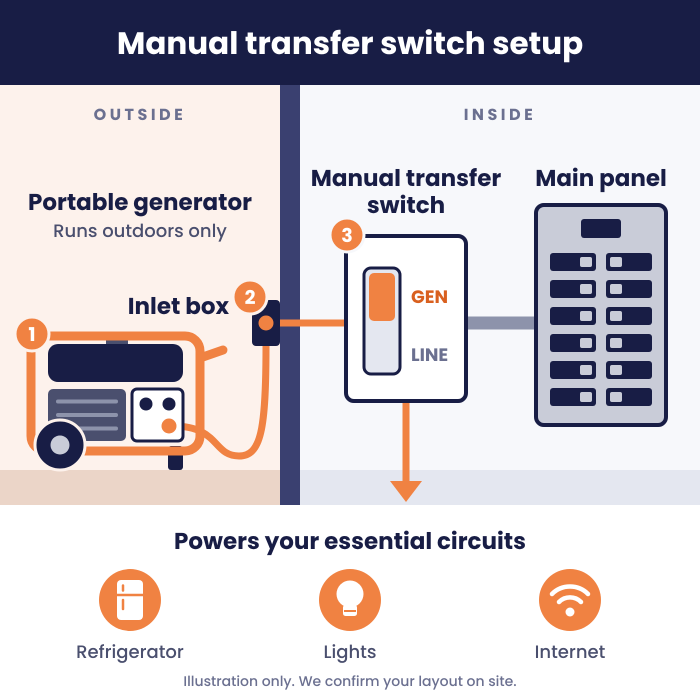
Lower-cost outage protection for essential circuits. You roll out a portable unit, fuel it, start it and move the switch by hand. It suits a small protected load and a household usually at home. It does nothing during a shutoff you left town for. We size the inlet box and the switch to the circuits you name.

Whole-home backup that starts on its own. The automatic transfer switch watches utility voltage, signals the unit and moves your protected circuits over within seconds, then transfers back and shuts down once SCE restores the line. Nobody has to be home. Natural gas units draw from the SoCalGas line, so there is no tank to refill during a shutoff running past 24 hours.
We size systems for Montclair houses on 1950s tract lots and for commercial sites along Holt Boulevard, Central Avenue and the Mission Boulevard corridor. Residential units generally land between 14kW and 26kW. Commercial work starts where the load calculation says it starts.


An automatic standby unit covers the whole house or a managed set of circuits, depending on the size you choose and the load management you allow. We show you both options with prices attached so the trade-off stays yours to make.
Size follows load, not square footage. A 1,400 square foot Montclair ranch house running a four-ton condenser and a pool pump needs more generator than a neighbor of the same size running a two-ton and neither. Six things drive the number in our load calculation:
Residential standby units in this market generally land between 14kW and 26kW. We quote the size the calculation supports and show you the managed-circuit alternative with its price, so the trade-off stays yours.
Pelican Coast Electric is an authorized Generac dealer working across Montclair, the Pomona Valley and the western Inland Empire. We hold California contractor license #1133193, classification C-10, and we perform the electrical, the gas connection and the permit work ourselves rather than handing it to a subcontractor.
Four steps, from the first visit to the day your Montclair generator runs its first self-test.

Site Assessment & Load Calculation
A licensed electrician measures your service capacity, walks the side yards, locates the gas meter and the panel, and runs the load calculation. You get a placement and a fixed price in writing before anything is ordered.

Permits & Gas Approval
We prepare the submittal and pull the City of Montclair electrical and building permits. If the load calls for a larger SoCalGas meter, that request goes in early, because it runs on the utility schedule rather than ours.

Professional Installation
Crews set the pad, place and anchor the unit, land the transfer switch at your service, then run and pressure test the gas line. On-site work for a typical Montclair home takes one to two days.

Testing & Homeowner Training
We schedule the city inspection, load test the system under real conditions and walk you through the controller, the weekly self-test and the maintenance interval before we leave.
⚡ Typical timeline: 1 to 2 days on site for most Montclair residential installations, plus City of Montclair permit review time.
Straight answers to what Montclair homeowners ask before they book an estimate.
A whole-home standby installation typically runs $10,000 to $20,000 in this market. The unit itself is usually 35 to 40 percent of the total. The rest is the automatic transfer switch, the concrete pad, the gas line, the electrical work, the permit and the load testing. Montclair compact tract lots tend to keep gas and conduit runs short, which helps, though narrow side yards occasionally push the pad to a costlier spot. Our whole house generator cost guide breaks the line items down.
Home Depot publishes an installation range of $5,000 to $12,500 depending on unit size, separate from the generator itself, and notes adding a propane tank runs another $5,000 to $8,000. The process starts with a free in-home consultation, and the work is performed by vetted local installers rather than store staff. Home Depot states its installation provider may be able to help with permits. With Pelican Coast Electric, the electrician who quotes your Montclair job is the one who performs it, and the City of Montclair permit is pulled under our C-10 license, number 1133193.
Not as a federal energy credit. The Residential Clean Energy Credit covers solar, wind and geothermal, and a standard natural gas or propane standby generator does not qualify. Three other routes exist. The cost counts as a capital improvement and adds to your home adjusted basis, which reduces taxable gain when you sell. A medically necessary generator is claimable as a medical expense under IRC Section 213, minus any increase it adds to your home fair market value, and only to the extent your total medical expenses exceed 7.5 percent of adjusted gross income. Rental property and qualifying home office use open depreciation. We are electricians, not tax advisors. Confirm any of this with your CPA.
Yes, when the system is sized for it. Air conditioning is the reason inland sizing differs from coastal sizing. A compressor draws several times its running current at startup, and a four-ton condenser on a Montclair tract house is common. A unit in the 18kW to 26kW range typically carries central air plus the rest of the house. A smaller unit still runs the AC when load management sheds other circuits while the compressor starts. We put both configurations in the estimate with prices attached.
Yes. In Montclair the work requires a permit and inspection covering the electrical connection and transfer switch, plus the gas line and pad. The Building Division operates out of Montclair City Hall, with a walk-in permit counter from 7:00 to 9:00 a.m. and 4:00 to 5:30 p.m. Permit status runs through 909-625-9433 and inspection results through 909-625-9449. Unpermitted electrical and gas work surfaces during resale disclosure and insurance claims, and correcting it later costs more than the permit did. We handle the paperwork as part of the job.
On-site installation is usually one to two days for a Montclair home. Total project time depends on permit turnaround at the city, equipment lead time for the size you select, and a SoCalGas meter upsize if your load calls for one. We give you a real calendar at the estimate, not a best case.
Yes. From the generator side, a PSPS is an ordinary outage. The transfer switch watches utility voltage, and the system is designed to start when that voltage disappears, whatever the cause. Because shutoffs sometimes run past 24 hours, a natural gas unit matters here, since there is no fuel tank to refill mid-event.
Annual service is the manufacturer standard, and every unit we install runs a scheduled self-test between visits. Inland heat and airborne dust in the Pomona Valley make oil and air filter intervals worth keeping on schedule. Our generator maintenance guide covers what a service visit includes.
Every Pelican Coast Electric installation meets the National Electrical Code, the California Electrical Code and City of Montclair requirements. A generator wired without a listed transfer switch backfeeds the utility line and endangers the SCE crews working to restore your street. Read more about transfer switch installation.

Proper isolation stops back-feeding into utility lines, which protects line crews and your equipment. Correct grounding and bonding on every install.

Work meets the National Electrical Code and the California Electrical Code, inspected by the City of Montclair

Licensed C-10 electricians, license #1133193, with permits, inspections, and complete documentation handed to you at closeout.
Montclair built out as post-war tract housing, most of it in the 1950s, and growth accelerated after the San Bernardino Freeway opened across the north side of town in 1958. The result is a city of modest single-story houses with attached garages, fenced yards, uniform front setbacks and curvilinear streets ending in cul-de-sacs. Those lots shape a generator install more than the generator does.

Where the Unit Goes
Standby generators carry manufacturer clearance requirements from windows, doors, vents and combustible walls, and Montclair enforces its own property line setbacks. Side yards on 1950s tracts are narrow. The gas meter usually sits on one flank of the house and the electrical panel on another, so the only viable pad location is often the one costing the most in conduit and gas pipe. We measure the side yards, the meter and the panel on the first visit, then quote the placement we intend to build. No pad gets poured on an assumption.

Service Capacity
Plenty of original Montclair services still run at 100 amps. The load calculation tells us whether the existing service carries an automatic transfer switch plus the circuits you want protected, or whether the design needs load management to stay inside the envelope. You get that answer in the estimate, in writing, before any equipment is ordered.
Generator installation across Montclair and the surrounding Pomona Valley and western Inland Empire cities. We also install backup generators on the coast, including backup generator installation in Dana Point. For the full service overview, see our generator installation page.


Live Google reviews for Pelican Coast Electric, pulled straight from our Google Business Profile.
Ready for the next shutoff? Our licensed electricians walk your Montclair property, run the load calculation and put a fixed price in writing.
Get a personalized quote for your Montclair installation.