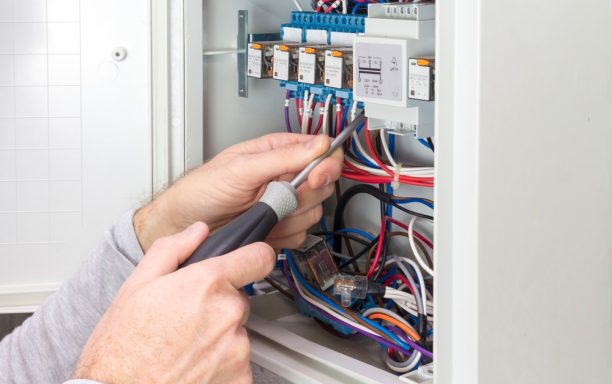
Your main panel has a fixed number of breaker slots. Once they fill up, adding a circuit means finding capacity somewhere else. A sub panel does exactly that. It takes one feeder from your main panel and turns it into a new bank of breakers, sited where the load lives.
Pelican Coast Electric installs sub panels across Orange County for ADUs, garage conversions, EV chargers, pool and spa equipment, and detached workshops. Licensed, permitted, inspected.

Panel & Sub Panel Projects Completed

Installation Available

& Insured

Most homeowners searching for a sub panel are asking a different question: do I need to replace my whole electrical service? Often the answer is no. The two jobs solve different problems.
A sub panel solves a space problem. Your service has capacity. Your panel has run out of breaker slots. Or the load sits 80 feet from the panel and running six separate home runs makes no sense. A sub panel distributes what you already have.
A service upgrade solves a capacity problem. Your total connected load exceeds what your service delivers. A 100 amp service feeding a 3,000 square foot home with a heat pump, an EV and a spa has a capacity problem. No sub panel fixes that. You need more amps at the meter.
A load calculation settles it. We run one before quoting either job. It totals your existing demand, adds the new load, and compares the result against your service rating. That number decides the job. Not a guess, and not an upsell. If the calculation shows you need more service, see our electrical panel upgrades and replacement page.

Out of breaker slots but under capacity means a sub panel. Over capacity means a service upgrade. A load calculation settles it.

All sub panel work is completed by licensed, insured California electricians, following the California Electrical Code and local Orange County permitting requirements.

Exceptional customer service with a lifetime warranty on all workmanship

Five situations account for most of the sub panel work we do across Orange County.
ADUs and garage conversions. An accessory dwelling unit draws roughly 80 to 100 amps once you count the kitchen, HVAC, water heating and laundry. A dedicated sub panel at the ADU, fed from the main house, keeps that load organized and gives the unit its own disconnect.
EV charger circuits. A Level 2 charger pulls 40 to 60 amps. If your main panel has no room, a small sub panel near the garage creates the slot and leaves space for a second charger later.
Pool and spa equipment. Pumps, heaters, blowers and lighting add up fast, and code requires specific disconnect and GFCI protection at the equipment pad. A sub panel at the pad consolidates the circuits and puts the disconnect where an inspector expects to find it.
Detached garages and workshops. A shop with a table saw, dust collection, a compressor and a welder needs real amperage at the far end of a trench. One feeder out, one sub panel at the shop, then every circuit branches locally.
Adding capacity without upsizing the main. Kitchen remodel, home office, whole-house fan. Any project adding four or more circuits to a full panel is a candidate. A sub panel costs less than replacing a service and takes a fraction of the time.

Size follows load, not preference. A 50 to 60 amp sub panel suits a spa pad or a small workshop on 6 AWG copper. A 100 amp sub panel handles a detached garage, an ADU or a heavy shop on 3 AWG copper. A 125 amp sub panel covers a full ADU with EV headroom on 2 AWG copper.
Two notes worth knowing before you buy anything. Slot count matters more than most people expect, because a 100 amp panel with 12 spaces fills faster than you think once tandem breakers are ruled out. We spec extra spaces on every install. Distance drives cost, because voltage drop over long runs forces larger conductors, and the trench is often the biggest line item.
We size ADU sub panels at 100 or 125 amps so there is headroom for an EV charger or a heat pump later. Garage conversions follow the same pattern.

Commercial tenants add load faster than their panels were designed for. A sub panel at the suite or equipment room distributes existing capacity to new equipment without touching the service, and keeps each disconnect where the inspector expects to find it.
We install three-phase and single-phase sub panels for tenant improvements, equipment rooms, rooftop units, warehouse shop floors and retail buildouts. Every job is permitted, inspected and documented, with a labeled directory handed over at closeout.
From load calculation to closed permit, we handle every part of your sub panel installation.

Site Assessment & Load Calculation

We walk the main panel, check available capacity and breaker space, measure the run, and calculate the load. You get a fixed quote with the sub panel size and feeder spelled out.

Permits & Utility Coordination
Sub panel work requires an electrical permit in Newport Beach and every surrounding Orange County city. We pull it. If the job touches the service or the meter, we coordinate with SCE.

Professional Installation
Feeder breaker set at the main panel, feeder run in conduit or trench, sub panel mounted and terminated, branch circuits landed, grounding electrode driven at detached structures. Neutral and ground stay separated per code.

Inspection & Walkthrough
We meet the inspector, close the permit, and walk you through the new panel with a labeled directory. Every breaker gets a label. Every label matches the circuit.
⚡ Typical timeline: 4 to 8 hours for an attached sub panel, 1 to 2 days for a detached structure with trenching
Get answers to the most common questions about sub panel installation
A sub panel is a secondary breaker box fed by a single circuit from your main panel. It does not add capacity to your service. It redistributes the capacity you already have to a new location with more breaker spaces.
If your service has spare capacity but your panel has no open slots, a sub panel solves it. If your total load exceeds what your service delivers, you need a full upgrade. A load calculation gives you the answer in about 20 minutes on site.
Every quote follows a site visit, so treat these as planning ranges. Nationally, sub panel installation runs about $500 to $2,000 installed depending on amperage, with permits at $50 to $350 and inspection at $100 to $250 on top. Orange County labor sits above the national average, and coastal jurisdictions add plan review time.
Four factors move the number more than anything else. Distance from the main panel, where wire runs $7 to $10 per linear foot and trenching adds $6 to $13.50 per foot. Amperage, since a 60 amp unit and a 125 amp unit use different conductors and breakers. Detached versus attached, because a separate structure needs a disconnect, a grounding electrode system and usually a trench. And the condition of the existing main panel, because a recalled brand or no room for the feeder breaker changes the scope. We tell you before we start, not after. Financing is available.
Attached sub panels usually finish in four to eight hours. Detached structures with trenching take one to two days including inspection. There is a temporary power shutoff while the feeder is landed at the main panel.
Yes. Every Orange County jurisdiction requires an electrical permit for sub panel work. Unpermitted panel work surfaces during resale and creates problems at escrow. We pull the permit and close it out.
Most ADUs draw 80 to 100 amps. We install 100 or 125 amp sub panels on ADU projects so there is headroom for an EV charger or a heat pump later.
It depends on the enclosure, not the amperage. A 100 amp sub panel comes in 12, 20 or 24 space configurations. We spec extra spaces so the panel has room for the next project.
Sub panels fail inspection for predictable reasons. We build to avoid all of them.
Neutral and ground separated. The neutral bus floats and the bonding screw comes out. A bonded neutral in a sub panel puts current on the ground path, and this is the single most common failure on DIY work.
Four-wire feeder. Two hots, a neutral and an equipment ground. Three-wire feeds to sub panels are no longer permitted.
Grounding electrode at detached structures. Per NEC 250.32, a separate structure gets its own grounding electrode system.
Correct sizing, clearance and enclosure. Conductors sized to the load and the termination rating, breakers sized to protect the conductor, clear working space in front of the panel, and rain-tight enclosures outdoors. Coastal Orange County adds a corrosion factor most inland electricians skip.
All work follows the California Electrical Code and local permitting requirements, performed by licensed, insured California electricians under CA License #1133193.

The neutral bus floats and the bonding screw comes out. A bonded neutral in a sub panel puts current on the ground path.

Four-wire feeders, correct conductor sizing, and a grounding electrode system at every detached structure.

Licensed electricians with permits, inspections, and documentation provided.



Real reviews from satisfied customers across Orange County.
Tell us what you are adding. We will tell you whether a sub panel handles it or whether the service needs to grow first. No charge for the assessment. Related services: EV charger installation, hot tub installation, cold plunge set up and electrical circuit installation.
Get a personalized quote for your sub panel installation