Pelican Coast Electric installs 240V outlets across Orange County. We check your panel capacity first, pull the permit and quote a fixed price.

Electrical Projects Completed

Service Available

& Insured

Most outlets in a home deliver 120 volts from one hot wire and a neutral. A 240V outlet draws from both hot legs of your service through a two-pole breaker.
Two details set a 240V outlet apart. The circuit is dedicated: one outlet, one appliance. And the receptacle shape is specific to the voltage and the amperage, so a 30 amp dryer plug does not fit a 50 amp range outlet.
Three signs point to a new 240V outlet.
The new appliance has a plug with nowhere to go. An electric dryer, an induction range or an EV charging cable arrives, and the wall has only standard outlets.
The plug and the outlet do not match. A four-prong dryer cord meets a three-prong outlet from before 1996, or a welder with a 6-50 plug meets a range outlet.
An adapter or an extension cord is doing the job. Adapters and cords are a temporary bridge, not a permanent supply for a 30 or 50 amp load.
A 240V outlet with scorch marks, a melted face or a burning smell is urgent. Switch the breaker off and see our emergency electrician page.
Five kinds of equipment account for most 240V outlet installs in Orange County homes.
Electric dryers. A 30 amp circuit and a four-prong NEMA 14-30 outlet. Homes built before 1996 often have the older three-prong 10-30, with no separate ground.
Electric and induction ranges. A 40 or 50 amp circuit and a NEMA 14-50 outlet, sized from the range nameplate. A switch from a gas range to induction is a common reason for this install.
EV charging. A NEMA 14-50 or 6-50 outlet on a 50 amp circuit supports charging at up to 40 amps, about 9.6 kW. A hardwired wall charger goes higher and adds scheduling features. Our EV charger installation page covers the charger choices, the brands and the rebates.
Shop tools. Welders, plasma cutters and kilns typically use a 50 amp NEMA 6-50. Table saws, dust collectors and air compressors typically use a 20 or 30 amp outlet, the NEMA 6-20 or 6-30.
Hot tubs and spas. Most full-size hot tubs run on a 240V, 50 amp circuit, usually hardwired through a GFCI disconnect within sight of the tub instead of an outlet. Our hot tub installation page covers the details.

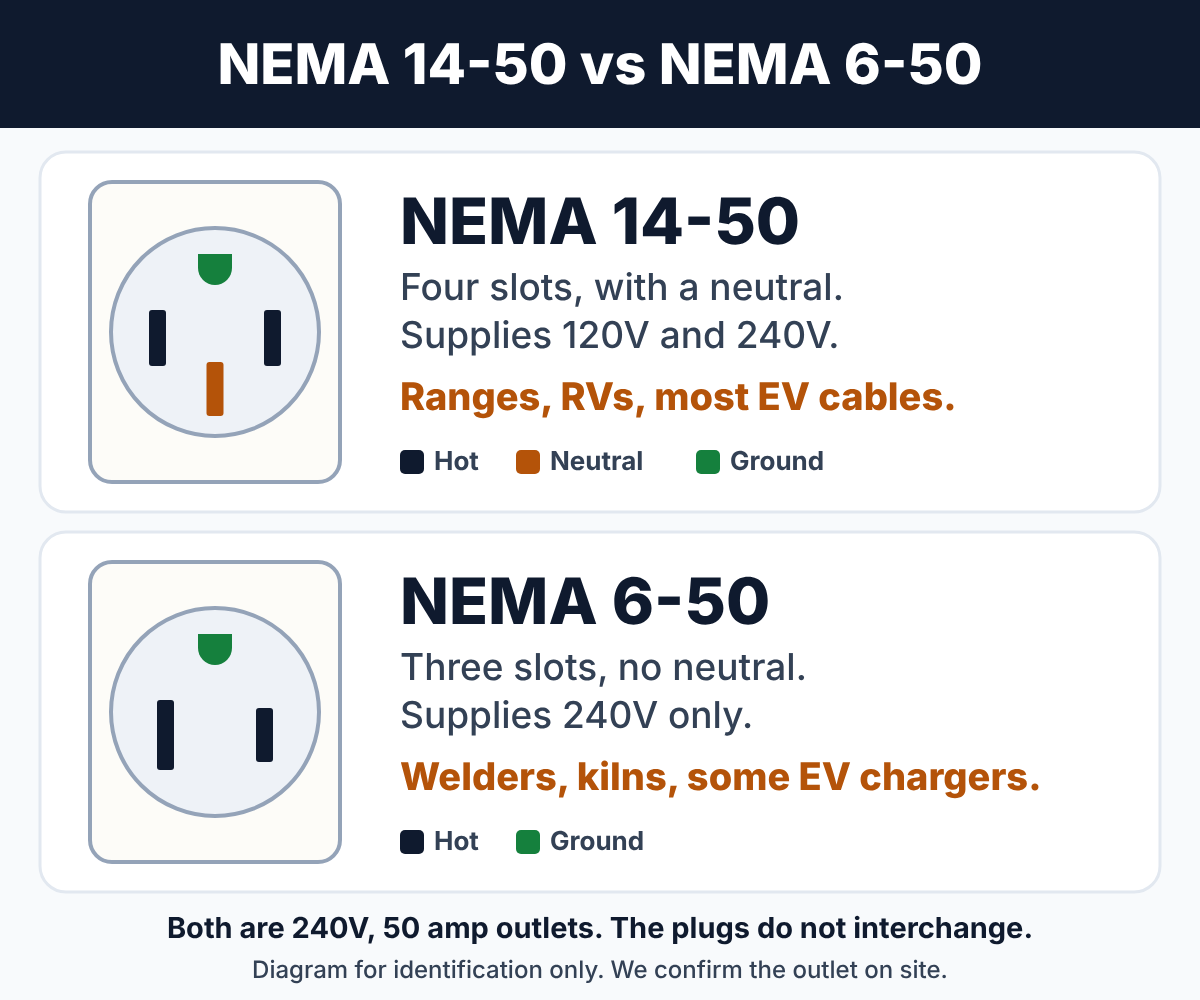
Both are 240V, 50 amp outlets. The 14-50 has four slots and a neutral. The 6-50 has three slots and no neutral.
All 240V outlet work is completed by licensed, insured California electricians, following the California Electrical Code.

Rated 5.0 across 50+ Google reviews. You get a fixed price before work starts.
NEMA sets the standard for outlet shapes in North America. The first number is the family: the 6 series is 240V with two hots and a ground, and the 14 series adds a neutral. The second number is the amperage.
These are the 240V outlets we install most.
NEMA 14-30. Four slots, 30 amps. Electric dryers.
NEMA 14-50. Four slots, 50 amps. Ranges, EV charging and RV hookups.
NEMA 6-50. Three slots, 50 amps. Welders, kilns and some EV chargers.
NEMA 6-20 and 6-30. Three slots, 20 or 30 amps. Compressors, saws and other shop equipment.
NEMA 10-30 and 10-50. The older three-slot dryer and range outlets. New circuits do not use them.
The outlet is one part of three. The breaker has to match the outlet rating, and the wire has to match the breaker. A 50 amp circuit typically runs on 6 gauge copper, a 30 amp circuit on 10 gauge and a 20 amp circuit on 12 gauge.
Both are 240V, 50 amp outlets, and both support the same 40 amp continuous load. The difference is one wire.
A NEMA 14-50 has four slots: two hots, a neutral and a ground. The neutral lets an appliance pull 120V for a clock, a light or a control board alongside the 240V load. The circuit needs four conductors.
A NEMA 6-50 has three slots: two hots and a ground. No neutral means the outlet supplies 240V only. The circuit needs three conductors, so a long run costs less in copper.
Choose a 14-50 when the outlet serves a range, an RV or an EV charging cable with a 14-50 plug. Most portable EV cables ship with one.
Choose a 6-50 when the outlet serves a welder, a plasma cutter or a kiln, or when your EV charger ships with a 6-50 plug. EV charging uses no neutral, so a 6-50 charges at the same speed as a 14-50.
The plugs do not interchange, so check the plug on your equipment first. For EV use, we install an industrial-grade receptacle rated for hours of continuous load, not a light-duty range outlet.
A new 240V circuit asks two things of your panel: space and capacity.
Space. A two-pole breaker takes two adjacent slots. When the slots run out, a sub panel installation adds room for new circuits without replacing the main panel.
Capacity. Open slots do not prove spare capacity. The California Electrical Code sets out a load calculation for adding a load to an existing home. We total your existing loads, add the new circuit and compare the result with the rating of your service. A 200 amp panel usually has room. A 100 amp panel with electric cooking, air conditioning and a new 50 amp circuit often does not.
When the calculation comes up short, you have three paths.
A smaller circuit. A 30 amp circuit still charges an EV at 24 amps, enough to cover most daily driving overnight.
Load management. A listed load management device pauses EV charging while the dryer or the range is running.
A panel upgrade. A 200 amp service gives room for the new circuit and for future loads. Our electrical panel upgrades and replacement page covers the process.
Treat these as planning ranges. HomeGuide puts 240V outlet installation at $250 to $800 nationally. Orange County labor sits above the national average.
Four factors move the number.
Distance from the panel. Wire is the largest material cost, and every foot of 6 gauge copper adds to the total.
Amperage. A 50 amp circuit takes heavier wire and a larger breaker than a 30 amp circuit.
The route. An open garage wall is fast. Finished walls, attic runs, exterior conduit and trenching add labor.
GFCI protection. A two-pole GFCI breaker costs more than a standard breaker.
A sub panel or a panel upgrade is a separate project with a separate quote. Permit fees vary by city. You get a fixed price before work starts.

Most residential calls fall into four jobs. A new dryer or range outlet during a remodel or a gas-to-electric switch. A garage outlet for EV charging. A shop outlet for a welder or a compressor. Or a three-prong dryer outlet converted to a grounded four-prong.
Every install is a dedicated circuit from the panel to the outlet. We size the breaker and the wire from the appliance nameplate, mount the outlet where the cord reaches without strain, and label the breaker in the panel. Garage and outdoor outlets get GFCI protection. Outdoor outlets also get a weatherproof in-use cover.

Commercial buildings add one question homes never raise: the supply voltage. Many commercial suites run on three-phase service delivering 208 volts between two hots, not 240. Some equipment accepts both. Some heats slower or draws more current on 208. We read the equipment nameplate and meter the supply before choosing the circuit.
We install 208V and 240V outlets for restaurant cooking equipment, commercial laundry, kilns, compressors, shop machinery and workplace EV charging. Locking outlets keep a plug seated on equipment exposed to vibration or foot traffic.
Out of breaker space in a commercial panel? See our commercial electrical panel upgrades page.
From the first look at your panel to the final inspection, we handle every step of a 240V outlet installation. Most installs take one visit once the permit is issued.

Panel Check & Fixed Quote
We read the appliance nameplate, check the panel for space, run the load calculation and plan the wire route. You get a fixed price.

Permit & Materials
We pull the electrical permit from your city and stock the outlet, the breaker and the wire sized for the circuit.

Circuit Installation
Power goes off and gets verified off. We install the breaker, run the cable or conduit, mount the box and tighten the terminals to the manufacturer torque values.

Testing & Inspection
We test the voltage at the outlet, trip the GFCI protection, label the breaker and schedule the city inspection.
⚡ Typical timeline: two to four hours for an outlet near the panel. Long runs, finished walls and exterior conduit take most of a day.
Get answers to the most common questions about 240V outlet installation
HomeGuide puts 240V outlet installation at $250 to $800 nationally. Distance from the panel, amperage and the wire route move the number. Treat these as planning ranges. Orange County labor sits above the national average. You get a fixed price before work starts.
Both are 240V, 50 amp outlets. A NEMA 14-50 has four slots, including a neutral, and supplies 120V and 240V. A NEMA 6-50 has three slots, no neutral, and supplies 240V only. Ranges, RVs and most portable EV charging cables use a 14-50. Welders, kilns and some EV chargers use a 6-50. The plugs do not interchange.
Yes. A new 240V outlet means a new circuit, and new circuits require an electrical permit and an inspection in Newport Beach and across Orange County. Replacing a worn outlet like for like is often treated as a minor repair. We confirm the requirement with your city before work starts.
The answer comes from a load calculation, not from counting open slots. We total your existing loads, add the new circuit and compare the result with your service rating. A 200 amp panel usually has room. A 100 amp panel sometimes needs a smaller circuit, a load management device or a panel upgrade.
A NEMA 14-50 or 6-50 outlet on a 50 amp circuit supports charging at up to 40 amps, about 9.6 kW, depending on the charging cable. For most drivers, an overnight session covers the daily miles. A hardwired wall charger supports higher amperage and adds scheduling and load sharing. See our EV charger installation page for the charger options.
Yes. 220V, 230V and 240V all describe the same residential circuit. The utility delivers a nominal 240 volts, and older appliances and labels still say 220. The outlet type and the amperage matter more than the label. A 30 amp dryer outlet and a 50 amp range outlet are both 240V, and the plugs do not interchange.
Yes. A three-prong 10-30 dryer outlet has no separate ground wire, and a four-prong 14-30 adds one. When the existing cable includes a ground, the conversion is an outlet swap. When the cable has no ground, we run a new four-wire circuit.
A 240V circuit must be sized for the equipment it supplies. Four details decide whether the install is safe.
A dedicated circuit. One outlet, one appliance, one breaker. Nothing else shares the wire.
Outlet, breaker and wire matched. The breaker protects the wire, so the wire gauge has to match the breaker rating. A 50 amp breaker on wire sized for 30 amps leaves the wire unprotected.
GFCI protection where the code requires. The California Electrical Code calls for GFCI protection on 125 volt through 250 volt receptacles in garages, outdoors, kitchens and laundry areas, and on receptacles installed for EV charging. In most homes this means a two-pole GFCI breaker in the panel.
Tight, torqued terminations. Loose connections generate heat at the outlet. We tighten every terminal to the manufacturer torque value.
All work follows the California Electrical Code, performed by licensed, insured California electricians under CA License #1133193.
A new 240V outlet is a new circuit, and a new circuit requires an electrical permit. Each city runs a separate building department, and unincorporated areas go through the County of Orange. Fees and turnaround times differ from city to city.
The permit covers the installation and a final inspection. The inspector checks the breaker size, the wire gauge, the grounding, the GFCI protection and the outlet rating.
Work with no permit required. Replacing a worn outlet on an existing circuit, like for like, is often treated as a minor repair. We confirm the rule with your city first.
Condos and HOAs. A garage outlet in a shared structure usually needs association approval. Our HOA and condo electrician page covers shared buildings.

Every outlet, breaker and GFCI device is listed and rated for the circuit.

Installed to the California Electrical Code under a city permit, with a final inspection.

Licensed, insured electricians. Voltage tested and the breaker labeled before we leave.



Real reviews from satisfied customers across Orange County.
Tell us what you are plugging in: a dryer, a range, an EV, a welder or a hot tub. Send a photo of the plug or the nameplate and a photo of your panel with the door open. We tell you the outlet type, whether the panel has room and what the work costs before we start. Related services: EV charger installation, electrical panel upgrades and replacement, sub panel installation and GFCI outlet installation.
Get a personalized quote for your 240V outlet installation