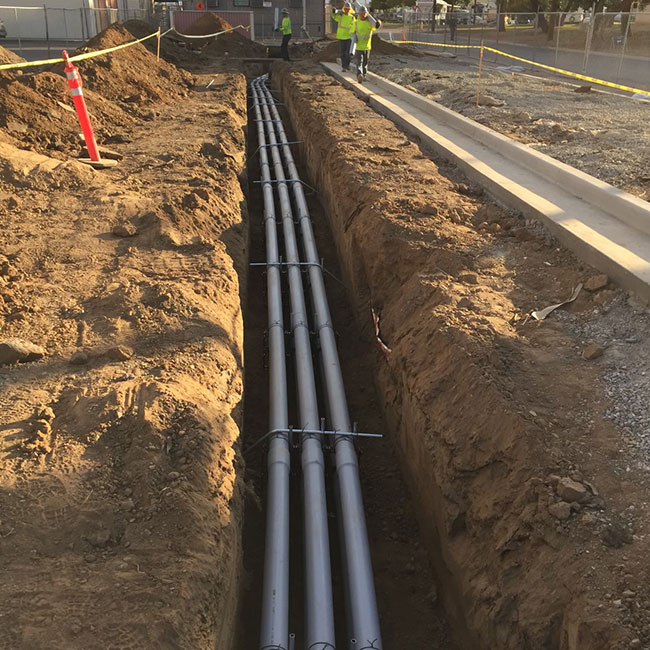

We replace the overhead wire from the pole to your roof with a buried service in conduit. We handle the trench, panel, permit and utility paperwork.

60+ Reviews

& Inspected

& Insured

Overhead to Underground Service Conversion
Older Orange County homes often take power through an overhead service drop. The utility’s wire leaves the pole, crosses the yard and lands on a mast above the roof. A conversion replaces the drop with a service lateral, a set of utility conductors pulled through buried conduit from the pole to a new meter panel.
Three situations start a conversion.

A new build, a rebuild or a large addition triggers the rule in several Orange County cities.

An underground utility district or an assessment district removes the poles. Every owner on the street converts a private service by a set deadline.

Owners convert by choice to clear a view, a driveway, a pool or a second-story addition.
This page covers the service conversion alone. Conduit runs for yard lighting, a detached garage, an ADU or a gate fall under our underground electrical conduit installation service.
Utility and City Rules
Three sets of rules decide whether your service goes underground.

SCE’s Electrical Service Requirements make overhead service unavailable wherever SCE or the local jurisdiction has designated an area for underground service. SCE’s Rule 16 requires underground service wherever a law or an ordinance calls for one.

SDG&E’s Rule 16 carries the same requirement. SDG&E serves southern Orange County, including San Clemente, Dana Point and San Juan Capistrano, along with San Diego County. Section 303 of SDG&E’s Service Standards and Guide covers an underground installation replacing an overhead service in both counties.

Local building codes hold the common trigger. Newport Beach applies the rule to a new or replacement building and to an addition past 50 percent of the gross floor area.
What about a panel upgrade alone?
A panel upgrade alone does not trigger an underground requirement under SCE’s service rules. SCE lists the same 400 amp normal maximum for overhead and underground single-phase service. Each city sets a separate rule, so we confirm with the building department and the utility planner before quoting. Our electrical panel upgrades and replacement page covers the panel side.
Newport Beach Rules on Underground Service
This is the trigger written into the Newport Beach code as of October 2026. Codes get amended, so the building department has the final say.

Newport Beach building code, October 2026
New Building
New or replacement building
50%+ Addition
Of the existing gross floor area
Owner, Electrician and Utility
SCE and SDG&E split the work the same way.

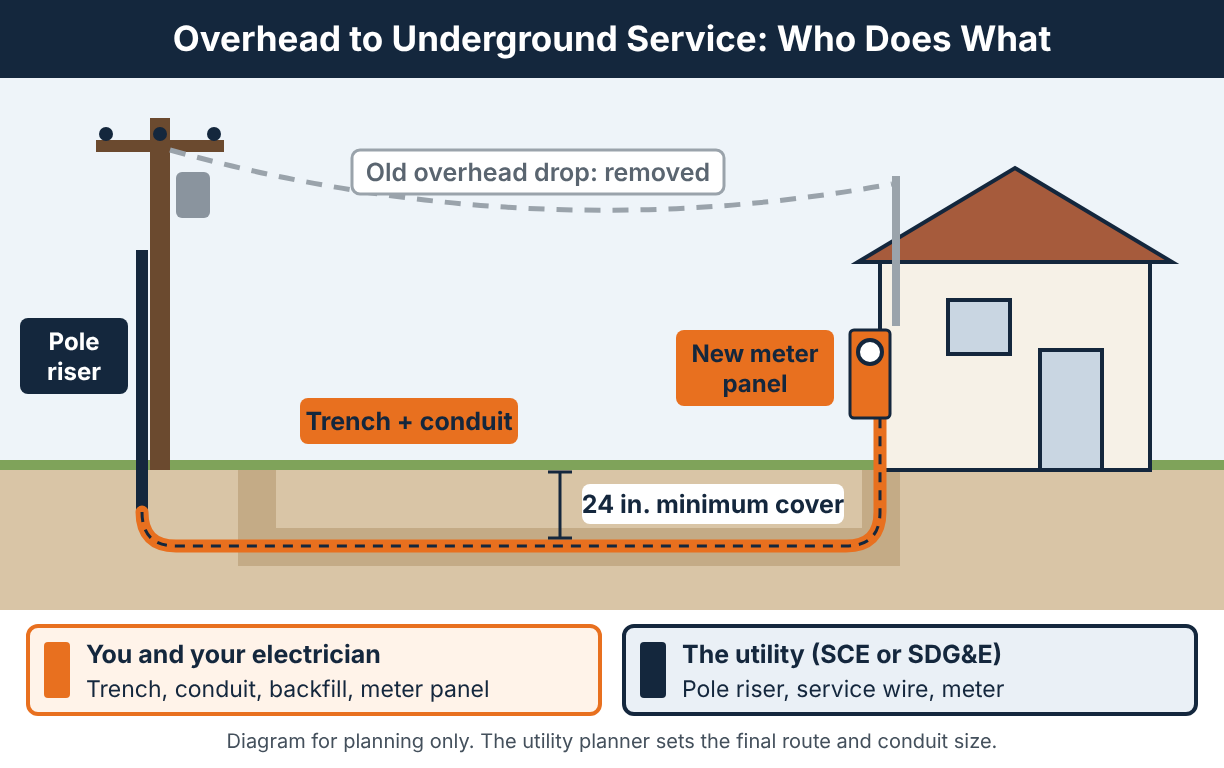
The utility sizes, pulls and connects the service conductors, installs and owns the riser on the pole, sets the meter and removes the old overhead drop.

You furnish and install the service conduit, the trench, the backfill, any pull boxes and a meter panel built for underground service. You also pull the electrical permit. As your contractor, we handle each of these.
2-1/2" to 3"
Conduit Size
24"
Minimum Cover
48 Hours
SCE Inspection Notice
What It Costs
SCE and SDG&E price each conversion by estimate, not from a flat price list. Two bills make up the total.

Priced by estimate, not a flat price list

$5,000 to $15,000
Contractor’s bill, Laguna Beach planning figure
By Estimate
Utility’s bill under Rule 16

You get a written fixed price for our scope before work starts.

A residential conversion in Orange County follows one pattern. A 100 or 200 amp overhead service on a roof mast gets replaced by a meter panel with an underground pull section, fed through conduit from the pole or from a utility stub at the property line.
We walk the route with you first. Concrete and pavers get saw-cut and patched. A conversion is a practical time to move up to 200 amps, because the panel is already being replaced.

Commercial conversions add equipment and coordination. A larger service often means a pad-mounted transformer, a pull section, a multi-meter panel and conduit runs sized by the utility planner.
We convert service for retail centers, offices, restaurants, warehouses, apartment buildings and HOA common areas. Shutdowns get scheduled around business hours, and tenants get notice before the cutover.
Our trench, conduit and panel work takes days. The utility’s design, inspections and crew scheduling set the calendar, so we file the utility request first.

Site Visit & Utility Request
We walk the trench route, check the meter location and confirm what your city requires. Then we file the service request with SCE or SDG&E.

Permit & Layout
We pull the city electrical permit and contact 811 at least two working days before digging. The utility planner confirms the route, the conduit size and the meter location.

Trench, Conduit & Panel
We dig to the utility’s depth, set the conduit and install the underground-ready meter panel. The utility inspects the trench before backfill.

Inspection & Cutover
The city inspects and releases the service. The utility pulls the new conductors, sets the meter and removes the overhead drop. We cut and cap the old mast.
Typical timeline: SCE publishes targets for SCE’s own steps only, an average of 30 business days for a main panel upgrade and 125 business days for a service extension project. You get a schedule once the planner is assigned.
Get answers to the most common questions about overhead to underground service conversion
Not under SCE’s service rules alone. SCE lists the same 400 amp normal maximum for overhead and underground single-phase service. The trigger sits in city and county codes. Newport Beach requires underground service for a new or replacement building, or an addition exceeding 50 percent of the existing building’s gross floor area. Unincorporated Orange County and Dana Point apply separate rules, tied to a new or relocated main building or a remodel past 50 percent of the existing building.
The property owner pays for the private side: trench, conduit, backfill, surface repair, the meter panel and the permit. Under Rule 16, an owner converting by choice also pays the utility’s estimated cost to install the new service and remove the overhead drop. Inside a Rule 20A district, a city has the option to fund up to 100 feet of the service lateral from utility work credits. Ask your city whether your district includes the allowance.
SCE and SDG&E price each conversion by estimate. The City of Laguna Beach tells owners in undergrounding districts to expect $5,000 to $15,000 for the private conversion work, separate from the district assessment. Trench length, surface type, service size and the meter panel move the number. You get a written fixed price for our scope before work starts.
SCE and SDG&E both require at least 24 inches of cover over the service conduit on private property. SDG&E requires 30 inches in the public right-of-way. The California Electrical Code allows 18 inches for PVC conduit in most yard locations, so the utility’s figure governs.
The trench, conduit and panel work on a typical home takes days. The utility’s design, inspections and crew scheduling set the rest of the calendar. District conversions run on the city’s schedule.
Yes. Newport Beach requires an electrical permit for the private conversion. The city’s conversion handouts list three inspections: the trench and conduit, the service release, and a final after the old mast is cut and capped. SCE energizes the new service only after the city releases the installation. We pull the permit and meet the inspector.
The city or county sends notice and a deadline. Each owner provides the underground connection on private property at the owner’s expense. In Newport Beach, Laguna Beach and unincorporated Orange County, the code gives an owner 30 days after formal notice. After the deadline, the agency has authority to do the work and place a lien on the property. An early start keeps the choice of contractor yours.
A service conversion puts a trench across a yard full of buried lines and ends at the utility’s live conductors. Four rules keep the job safe.
811 before digging. California law requires notice to the regional notification center at least two working days, and no more than 14 calendar days, before excavation. We dig by hand near marked gas, water and communication lines.
Utility depth, not code minimum. The conduit gets 24 inches of cover or more, deeper wherever the planner or a joint trench requires.
A clear conduit. SCE requires the conduit to be proven clear with a mandrel and left with a pull rope for the utility crew.
Utility conductors stay with the utility. We never cut, splice or move the service drop, and we never work on the pole. The utility makes the connection after the city releases the installation.
All work follows the California Electrical Code and the utility’s service standards, performed by licensed, insured California electricians under CA License #1133193.
Rule 20 is the tariff SCE and SDG&E follow when a whole street goes underground. Under Rule 20A, a city or the county creates an underground utility district by ordinance. In an assessment district, the model used in Newport Beach and Laguna Beach, the owners on the street fund the project.
The private service is the owner’s job in every case. You hire the electrician, convert the panel and run conduit to the connection point at the property line. Newport Beach notifies owners in writing when private conversions are allowed to begin.
Funding has changed. The CPUC stopped new Rule 20A work credits after 2022, and unused credits expire by the end of 2033. Confirm with your city before counting on a utility allowance for your lateral or your panel.
Deadlines carry weight. Once notice is served, the owner has a set window to finish. Miss the window and the agency has authority to complete the work and lien the property.

Schedule 40 or Schedule 80 PVC conduit and listed meter panels accepted by SCE and SDG&E.

Installed to the California Electrical Code and the utility's service standards, with city inspection before the cutover.

Licensed, insured electricians. Every trench inspected by the utility before backfill.



Real reviews from satisfied customers across Orange County.
Tell us what you have. A notice from the city, a remodel plan with an underground condition, or an overhead wire you want gone. We check the city code and the utility requirements, walk the trench route and give you a written price for our scope. Related services: underground electrical conduit installation and electrical panel upgrades and replacement.
Get a personalized quote for your underground service conversion