

Your generator sits outside your house 365 days a year. It runs a weekly self-test you never hear. And when a Santa Ana windstorm knocks out power to your neighborhood, you expect it to fire up in 10 seconds flat.
That only happens if the unit is maintained.
Skipping maintenance is the number one reason generators fail during outages. A clogged air filter, dead battery, or degraded oil turns your $10,000+ investment into a metal box on a concrete pad. Here is what you need to do to prevent that, broken down by weekly, monthly, quarterly, and annual tasks.
Why Generator Maintenance Matters in Orange County
Southern California Edison runs Public Safety Power Shutoffs (PSPS) during high fire-risk weather. These events have affected Orange County multiple times, including inland areas near the hills. During the December 2024 PSPS event, over 51,000 customers in the San Diego and Orange County territory lost power for up to three days.
When your generator is maintained, a PSPS is an inconvenience. When your generator is neglected, a PSPS is a crisis. Your refrigerator stops. Your sump pump stops. Your medical equipment stops. Your security system goes dark.
A maintained standby generator lasts 20 to 30 years. A neglected one fails within a decade. The difference is a few hours of attention per year.
Weekly Tasks (5 Minutes)
Your Generac, Kohler, or Briggs and Stratton unit runs a weekly self-test automatically. Most models exercise for 12 to 20 minutes on a set schedule. Your job is to check on the unit after one of these cycles.
Walk out to the generator and look for these things:
Visual check for oil puddles or coolant leaks around the base. Any fluid on the ground means something is wrong. Do not wait to call a licensed electrician.
Look at the control panel display. If your Generac shows a “Service Schedule A” or yellow warning light, maintenance is due. Kohler units display “Maintenance Due” on the Decision-Maker controller. Do not ignore these alerts.
Check that the area around the unit is clear. Leaves, cobwebs, and debris block airflow. In Orange County, coastal moisture and salt air create additional corrosion risks, especially in Newport Beach, Huntington Beach, and Dana Point. Wipe down the enclosure if you see buildup.
Listen during the next exercise cycle. Grinding, knocking, or sputtering sounds signal a problem. A healthy generator hums steadily at a consistent RPM.
Monthly Tasks (15 Minutes)
Once a month, take a closer look at the unit while it is running or right after its weekly exercise.
Check the engine oil level using the dipstick. Oil should be between the low and high marks. If your generator has been running during an outage, check the level more frequently. Generac standby units hold 1.7 to 2.0 quarts, so even a small drop matters.
Inspect the air filter. Pull it out and hold it up to a light source. If you cannot see light through the filter material, replace it. In areas like Anaheim Hills, Yorba Linda, or Lake Forest where construction dust and pollen are common, filters clog faster.
Test the battery voltage with a simple multimeter. A healthy generator battery reads between 12.4 and 12.7 volts. Anything below 12.0 volts means the battery is failing. Generator batteries typically need replacement every 2 to 3 years. A dead battery is the single most common cause of a generator failing to start during an outage.
Run the unit under load for at least 30 minutes. This means turning on enough circuits to give the generator real work. Running without load (called “wet stacking”) causes unburned fuel to build up in the exhaust system. Over time, this damages the engine.
Quarterly Tasks (30 Minutes)
Every three months, go a step deeper.
Inspect all coolant lines and hoses. Look for cracks, bulges, or soft spots. Orange County heat, which regularly exceeds 90 degrees in inland cities like Tustin, Irvine, and Mission Viejo during summer, accelerates hose deterioration.
Check the spark plug. Remove it and inspect the electrode. A light tan or gray color means the engine is running clean. Black carbon buildup or a white, blistered electrode means the fuel mixture is off. Most residential generators need new spark plugs every 100 hours of runtime or once per year, whichever comes first.
Test the automatic transfer switch (ATS). This is the device that detects a power outage and tells your generator to start. Testing the ATS involves turning off your main breaker to simulate an outage. Your generator should kick on within 10 to 30 seconds. If you are uncomfortable doing this yourself, schedule a professional test. A faulty ATS means your generator sits idle during the exact moment you need it.
Inspect all belts for cracks, fraying, or looseness. Heat and wear degrade rubber belts over time. A broken belt during a multi-day outage leaves you without power until a repair tech arrives.
Annual Professional Maintenance
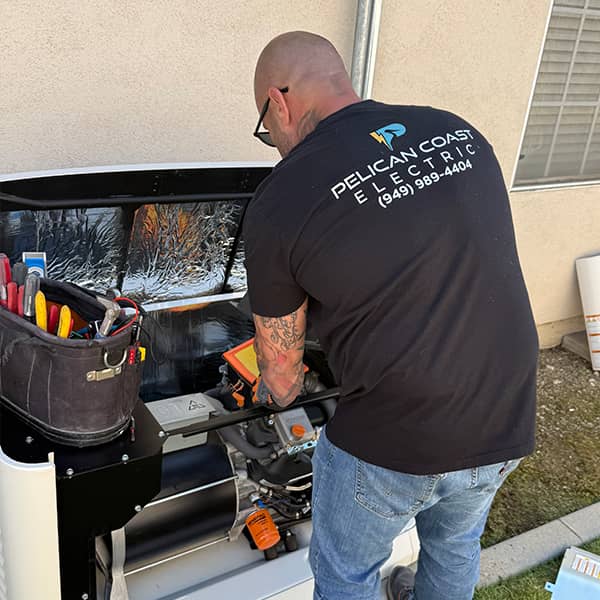
Once per year, have a licensed electrician perform a full service. This is the single most important maintenance event for your generator.
A professional annual service includes:
Oil and oil filter change. Generac recommends the first oil change at 25 hours of runtime, then every 100 to 200 hours or annually. Most residential generators in Orange County accumulate fewer than 100 hours per year, so the annual schedule applies. SAE 10W-30 is the standard oil type for most conditions. In cooler periods, SAE 5W-30 synthetic works better for cold starts.
Air filter replacement. Even if the filter looks clean, replace it during annual service. Dust particles too small to see reduce engine efficiency over time.
Coolant level check and top-off. The coolant prevents overheating during extended runs. Your technician will also check the coolant concentration to provide proper protection.
Battery load test and terminal cleaning. A multimeter reading tells you the charge level, but a load test reveals whether the battery holds up under the demand of starting the engine. Corroded terminals add resistance and slow startup.
Full electrical system inspection. This covers the wiring connections between the generator, transfer switch, and your main panel. Loose connections create heat, which creates fire risk.
Load bank test. Your technician runs the generator at full rated capacity to confirm it produces clean, stable power. This test catches voltage regulation problems that light-load operation hides.
Valve adjustment. Generac air-cooled generators need periodic valve adjustments. Skipping this step leads to hard starts, RPM fluctuations, and eventually, an “Overcrank” fault that prevents the unit from starting.
Control panel diagnostic check. Modern generators store fault codes and runtime data. A trained technician reads this data to spot patterns before they become failures.
What Annual Service Costs
Professional generator maintenance in Orange County runs between $150 and $300 for a standard residential unit. This covers the oil change, filter replacements, and basic inspection. More extensive service that includes load testing, valve adjustment, and full electrical checks ranges from $300 to $600.
Compare that to emergency repair costs. The average generator repair runs $200 to $600. A failed stator or alternator replacement costs $250 to $1,500. And if your generator fails during a PSPS event, you face spoiled food ($300 to $500 for a full refrigerator and freezer), potential water damage from a failed sump pump, and the cost of a hotel if the outage lasts more than a day.
Annual maintenance pays for itself every time.
The Warranty Factor
Most generator manufacturers require proof of professional maintenance to honor warranty claims. Generac, Kohler, and Briggs and Stratton all include maintenance requirements in their warranty terms. A standard residential warranty covers 5 years of parts. Extended warranties go up to 10 years.
If your generator fails due to a worn component and you have no maintenance records, the manufacturer will deny the claim. Keep every service receipt. Ask your technician for a written summary of each visit.
Orange County-Specific Maintenance Concerns
Coastal salt air in cities like Newport Beach, Costa Mesa, Seal Beach, and Laguna Beach accelerates corrosion on generator enclosures, electrical connections, and metal components. Wipe down exposed surfaces quarterly. Ask your technician to inspect for corrosion during annual service.
Inland heat in communities like Anaheim, Fullerton, Orange, and Yorba Linda puts extra stress on coolant systems and rubber components. Generators in these areas benefit from semi-annual coolant checks instead of quarterly.
Santa Ana winds carry fine dust and debris. After a major wind event, inspect your generator air filter and the area around the unit. Clear any debris from intake vents.
Earthquake risk adds another consideration. After any significant seismic event, inspect the gas line connections to your generator. A damaged or loosened gas line is both a fire hazard and a reason your generator will fail to start.
When to Call a Licensed Electrician
Handle the weekly and monthly checks yourself. Call a professional for the annual service and any time you notice:
Oil or coolant on the ground under the generator.
Warning lights or fault codes on the control panel.
The generator fails to start during its weekly exercise.
Strange sounds, vibrations, or exhaust smells during operation.
Visible corrosion on wiring or connections.
The generator starts but shuts down after a few seconds.
Any electrical work involving the transfer switch, main panel, or gas connections.
Generator maintenance involves both mechanical and electrical components. A licensed C-10 electrical contractor has the training to work on both sides safely. This is important in Orange County, where gas line regulations and electrical codes are strictly enforced.
Pelican Coast Electric proudly serves homeowners throughout Orange County with professional electrical panel inspections and upgrades. Whether you’re planning renovations, adding new electrical loads, or simply want peace of mind, our team is ready to help.
Contact Pelican Coast Electric today to schedule your electrical panel assessment and find out what to expect from a safe, compliant upgrade in Orange County.