
Written by the Pelican Coast Electric team. Updated September 2026.
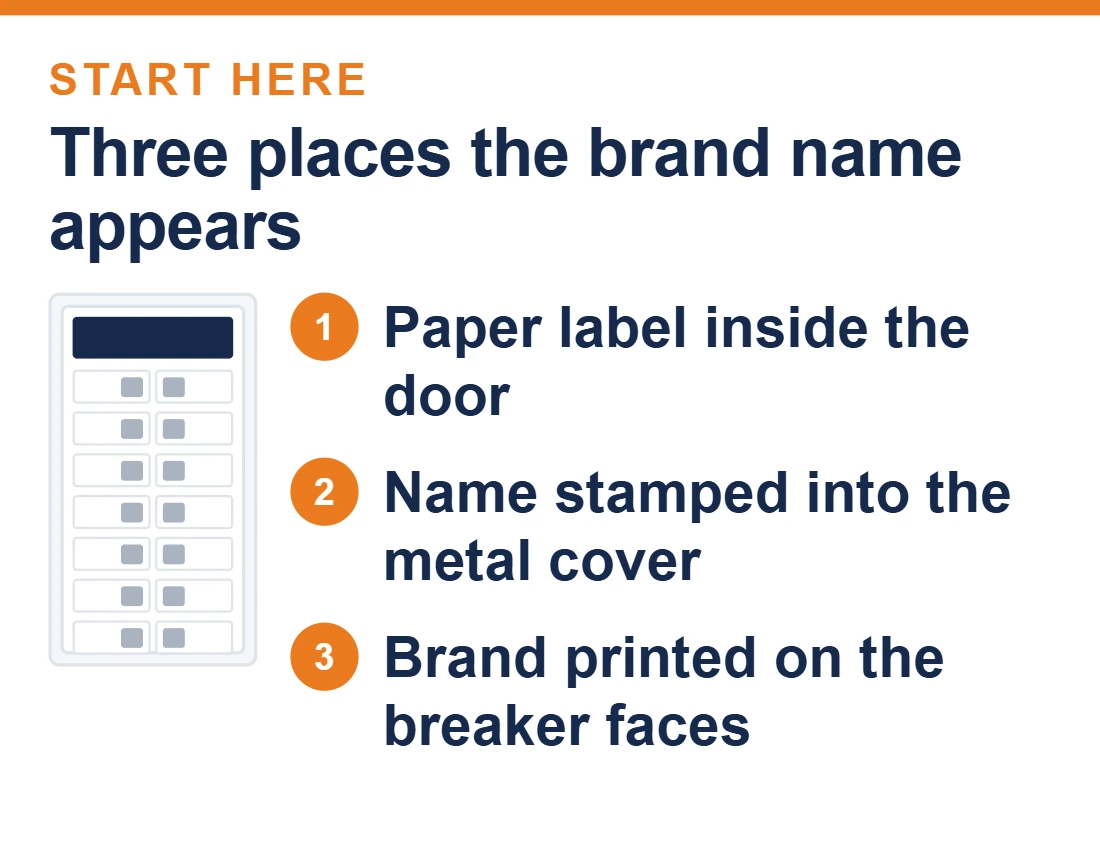
Your panel brand is printed in one of three places: on a paper label inside the door, stamped into the metal cover, or on the face of the breakers. Open the outer door and look. No tools, and no need to remove any cover. If the enclosure is damaged or anything inside is exposed, leave the door shut and read the safety note below.
Four brands matter in Southern California homes: Zinsco, Federal Pacific, Challenger and Pushmatic. All four went out of production decades ago. Which one you have changes what an insurance carrier says about your house and what a buyer’s inspector writes in the report.
Here is how to read yours.
The Three Places the Brand Name Appears
Most panels carry the name in more than one spot. Check all three before deciding you have an unmarked panel.
The label inside the door. Swing the outer door open. A paper or foil label sits on the inside face. It lists the manufacturer, a catalog number, and the breaker types the panel accepts. The “use only type ___ breakers” line is a strong clue on its own.
The cover itself. Zinsco, Federal Pacific and Challenger all stamped their names into the steel. Sun and paint destroy printed labels. Embossing survives. Hold a flashlight at a low angle across the cover and the letters show up.
The breakers. Breaker faces and handles carry a brand or a product line name. In a panel where somebody painted over everything else, the breakers are often the last readable evidence.
What to Check Yourself, and Where to Stop
On intact equipment, opening the outer door is a normal homeowner task. No tools, and no cover comes off.
Stop and call an electrician instead if the enclosure is rusted through, the door is warped or missing, you see scorch marks or melted plastic, you smell burning, you hear buzzing or crackling, the panel is wet, or any wire, terminal or metal part is exposed through a gap. In those cases leave the door shut. Everything past the outer door belongs to a licensed electrician either way.
Leave the inner cover alone. The deadfront is the flat metal panel held on by four to six screws. Behind it sit the bus bars and the service lugs, and the lugs stay energized with the main breaker off.
Photograph instead of leaning in. Hold your phone at arm’s length, use the flash, and read the photo afterward. You get a sharper look at the label than you would with your face near the equipment.
Write down four things. Brand name, catalog number, the amp rating stamped on the main breaker, and the year on the label if one is printed. Those four items tell an electrician most of what they need before arriving.
Zinsco and Sylvania-Zinsco
Zinsco built panels in Los Angeles, so these cluster in California homes. Martin Zinsmeyer renamed the family firm Zinsco Electric in 1943 and sold it to GTE-Sylvania in 1973. Production did not stop at the sale. GTE-Sylvania kept building the same breaker design under Sylvania labels, and the line ran on into the 1980s before it passed to Challenger (Zinsco panel age chronology). That is why a panel badged Sylvania can hold Zinsco equipment.
What to look for:
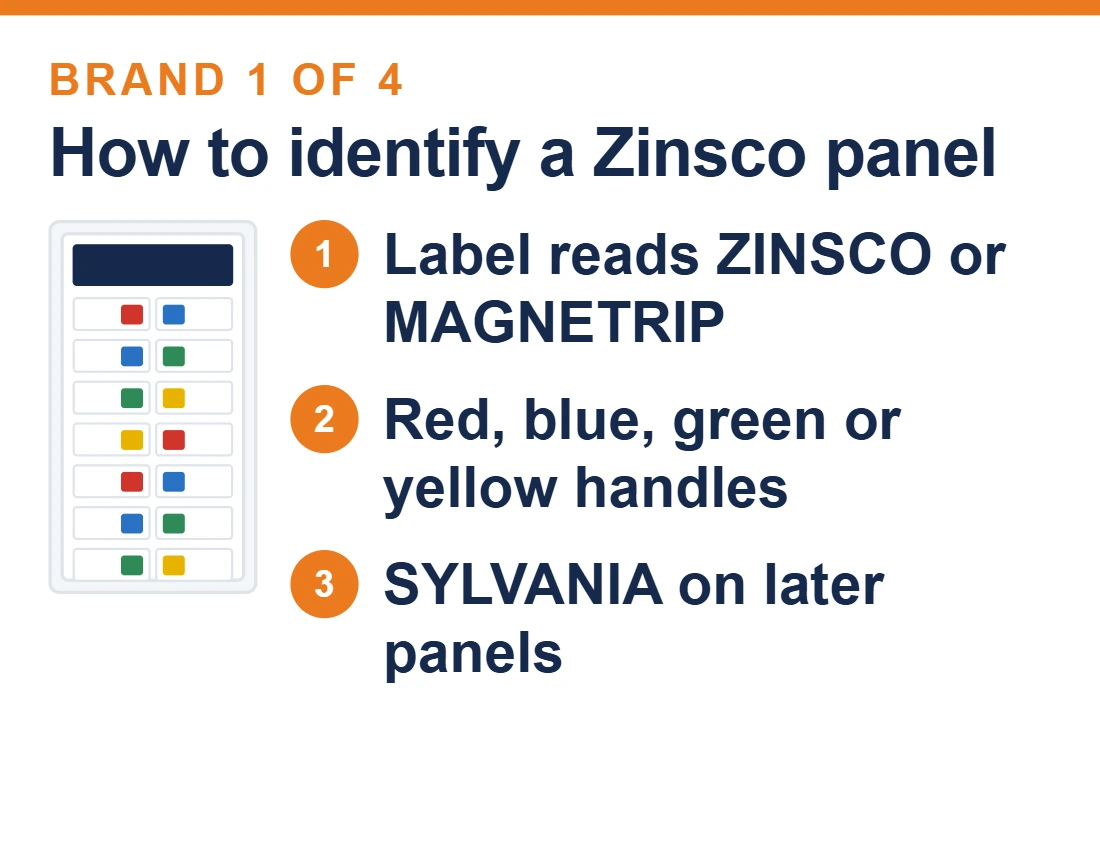
- ZINSCO or MAGNETRIP on the door label or embossed in the cover
- SYLVANIA on a panel with colored breaker handles, which means a Sylvania-Zinsco unit rather than a modern Sylvania panel
- Breaker handles in red, blue, green, yellow, gray or black. Color coded handles are the fastest tell, because no modern residential panel uses them
- A small service by current standards, which reflects when the panel went in rather than the brand
What is documented: the breaker clips onto an aluminum bus bar, and that clip connection loosens, arcs and overheats over time. Inspectors have photographed breakers welded to the bus and no longer able to trip. Original-manufacturer breakers left production decades ago, so replacements come from aftermarket UL-classified lines (replacement breaker catalog), and those catalogs list no AFCI option for this bus.
Federal Pacific Electric Stab-Lok
Federal Pacific panels went into homes nationwide between roughly 1950 and 1980. Orange County tract housing built from 1965 onward is full of them.
What to look for:
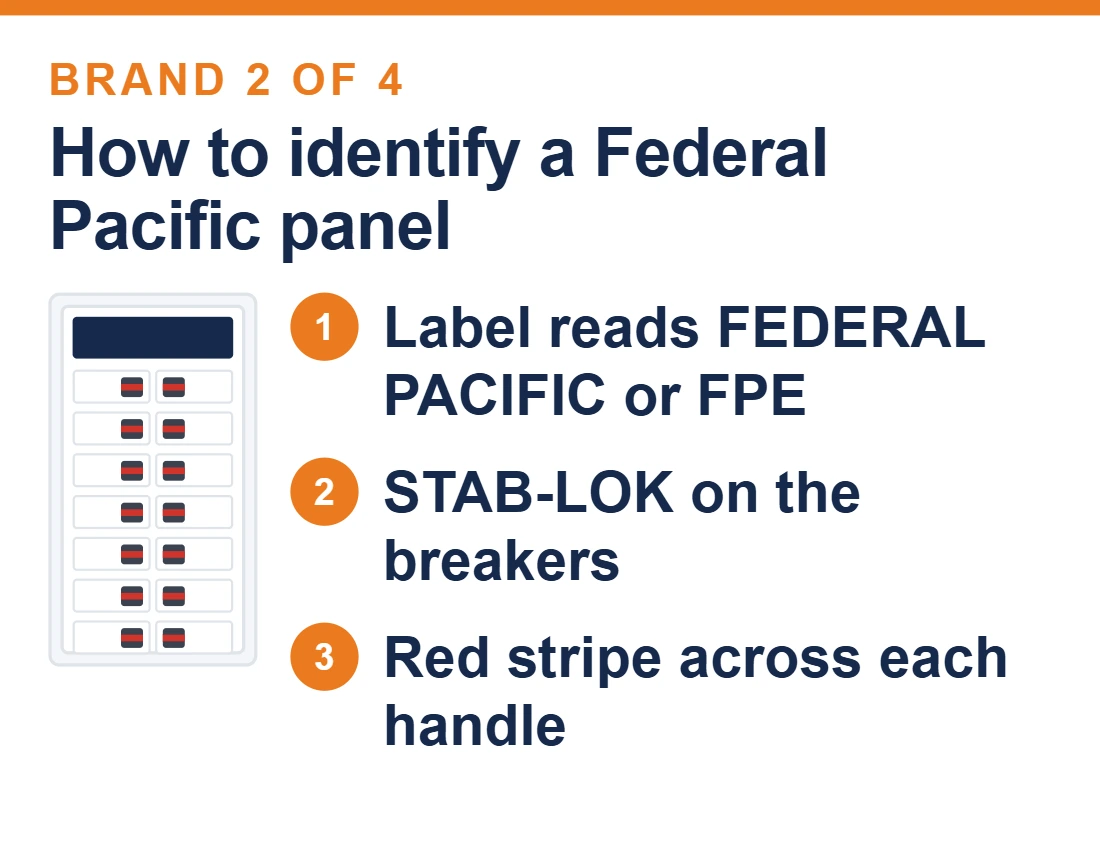
- FEDERAL PACIFIC ELECTRIC, FEDERAL PACIFIC or FPE on the door label, often embossed in the steel cover as well
- The STAB-LOK name on the breakers and frequently on the deadfront
- A red stripe running across the face of each breaker handle. This is the clearest single marker
- FEDERAL PIONEER or FEDERAL NOARK, the same Stab-Lok design under earlier or Canadian branding
What is documented: in testing carried out for the Consumer Product Safety Commission at Wright-Malta Corporation around 1980, 122 two-pole Stab-Lok breakers were loaded to 135 percent of their rating. 51 percent of individual poles failed to trip inside the UL calibration window, and 25 percent failed when both poles were loaded together (Aronstein test summary, PDF). The CPSC opened its investigation in June 1980 and closed it in March 1983 without reaching a determination, stating that the data then available did not establish that the breakers posed a serious risk of injury and that further testing would cost more than the agency could fund (CPSC closing statement). In the New Jersey class action Yacout v. Federal Pacific Electric, Superior Court of New Jersey, Law Division, docket L-2904-97, the court found that the company distributed breakers labeled as UL tested when they had not passed those tests. The case settled in 2008 (class action notice and settlement).
Challenger
Challenger panels turn up in homes built through the 1980s and into the early 1990s, including a lot of early Inland Empire tract housing.
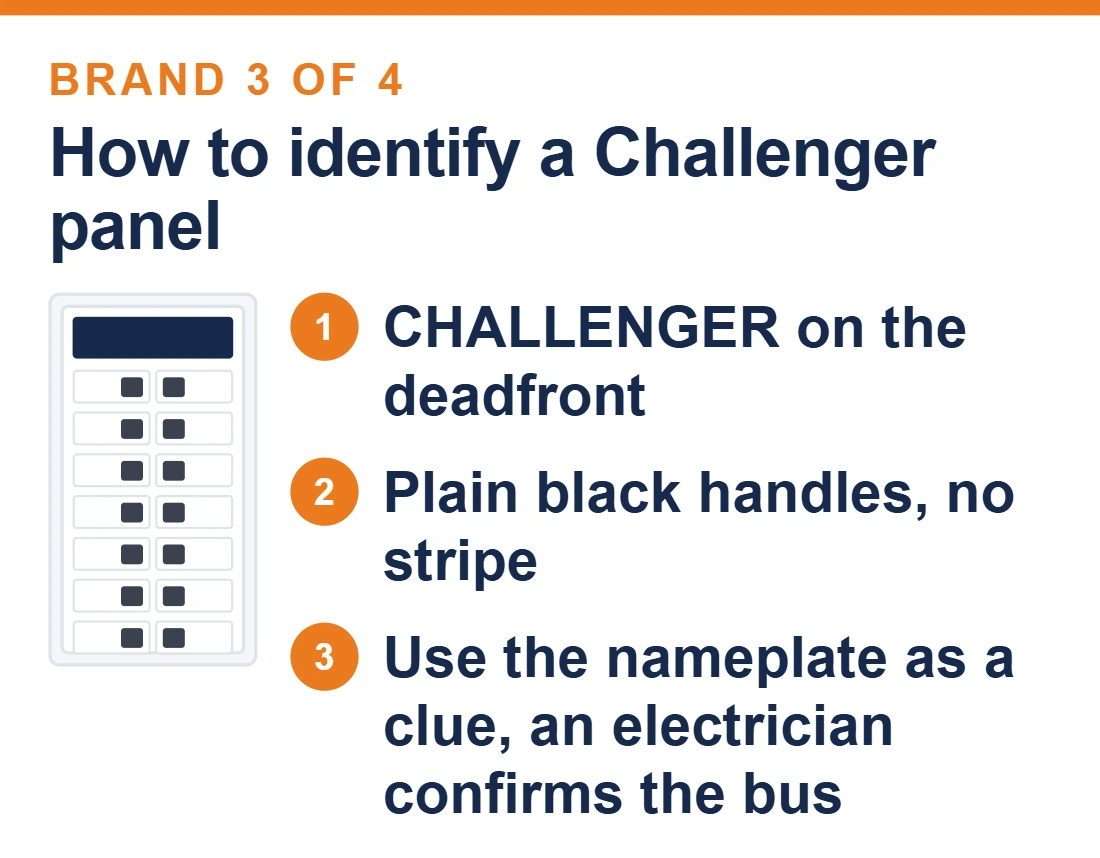
Challenger is the hardest of the four to spot, because nothing about the breakers gives it away. Standard black toggle handles, no color coding, no stripe. The nameplate on the deadfront is the only place the brand name appears, so read that first. It names the brand, not the bus behind it.
What to look for:
- CHALLENGER on the deadfront or the door label
- GFCI breakers marked HAGF-15 or HAGF-20, which carry a yellow test button
- A larger service than the three older brands, since these panels went in later
One wrinkle: Challenger sits on both sides of this list. It took over the Zinsco design line from GTE-Sylvania, and in 1986 it bought Federal Pacific’s Newark breaker plant as Reliance Electric left the business (Federal Pacific corporate history). Some Challenger equipment carries Stab-Lok style parts and some accepts Eaton Cutler-Hammer type BR breakers. The nameplate alone will not tell you which. An electrician confirms it by looking at the bus.
What is documented: on 12 November 1988 the CPSC announced a replacement program for roughly 9,000 Challenger GFCI breakers, types HAGF-15 and HAGF-20, after a mechanical part was found to detach and disable the ground fault function (CPSC replacement program notice). The action covered those two GFCI breaker types. It did not cover panels or standard breakers.
Pushmatic and Bulldog
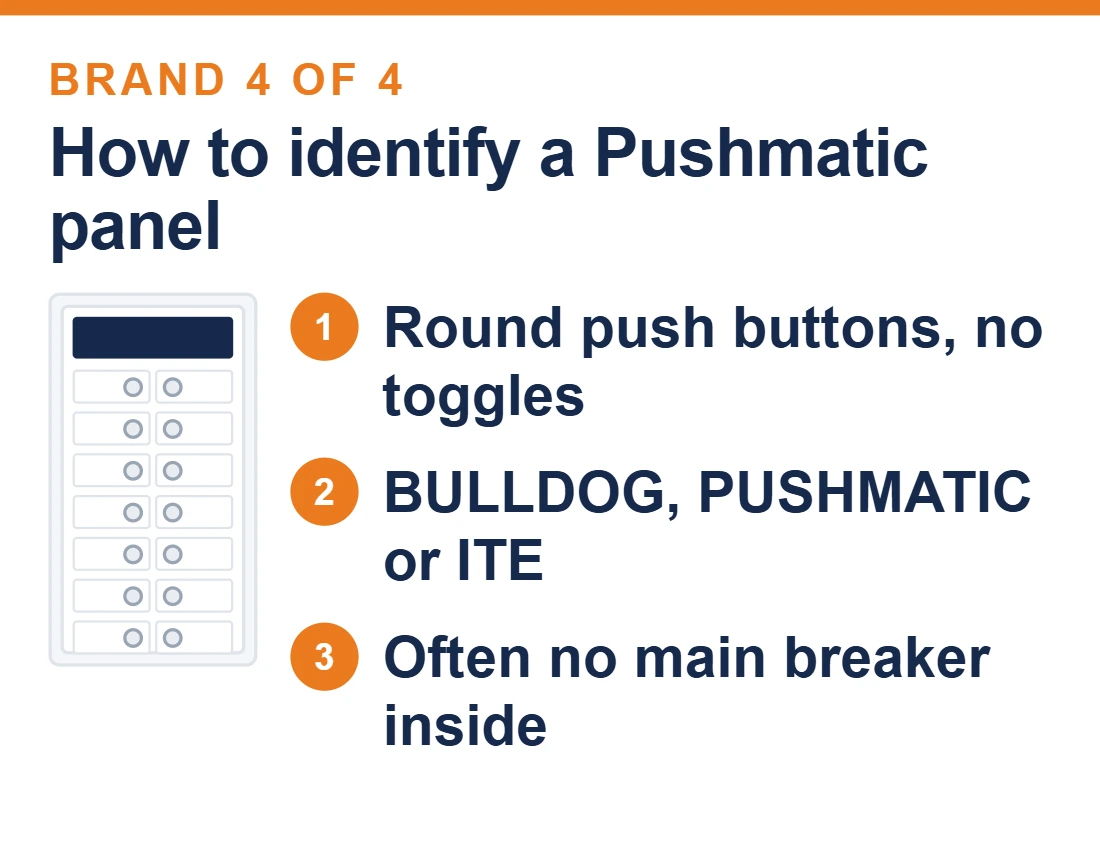
Bulldog Electric Products started in Wheeling, West Virginia in 1902 and built Pushmatic breakers from the 1930s on, with most installations landing between 1950 and 1970. Bulldog became a division of the I-T-E Circuit Breaker Company in 1954 (Bulldog Electric company history). I-T-E merged into ITE Imperial in 1968, Gould bought the business in 1976, and Siemens acquired it in 1983.
Pushmatic is the easiest of the four to spot from across the garage. There are no toggle handles at all.
What to look for:
- Round push buttons in place of switch handles. You push the button to trip or reset
- BULLDOG, PUSHMATIC, ITE PUSHMATIC or BULLDOG CONTROLS on the nameplate
- Frequently no main disconnect inside the panel
- A small service by current standards, since these panels predate modern household loads
What is documented: the earliest designs are thermal only, with no magnetic trip element, and the mechanisms stiffen with age when nobody exercises them. Replacements come from aftermarket UL-classified lines rather than the original manufacturer (replacement breaker catalog), and those catalogs list no AFCI option for this bus. No study shows unusually high failure-to-trip rates, and plenty of electricians consider the mechanism sound.
The Four Names You Will Be Glad to Read
Four brands come up constantly in Orange County panels, and none of them raises a flag on its own:
- Square D, usually a QO or Homeline panel
- Eaton or Cutler-Hammer
- Siemens
- GE
Reading one of these on your label settles the brand question. Age and capacity are separate questions. A 100 amp Square D panel from 1978 is still a 100 amp panel, and a house running a heat pump, an induction range and an EV charger needs more room than it has. Capacity work is covered on our electrical panel upgrades and replacement page.
When There Is No Label at All
Painted-over covers, sun-bleached labels and missing doors are common. Work the problem in this order.
Start with the build year of the house. Build era narrows the field fast. In Southern California, 1950 to 1972 points at Zinsco. 1965 to 1980 points at Federal Pacific. 1980 to 1992 points at Challenger. Before 1960 points at Pushmatic or Bulldog.
Read the breaker style. Colored handles, red stripes and round push buttons each identify a brand with no label at all.
Check the main, not the subpanel. A remodel often adds a modern subpanel and leaves the original main in place. The subpanel label tells you nothing about the equipment feeding it.
Send a photo. If the answer is still unclear, a photo of the open door and the breakers is usually enough for an electrician to name the brand before anyone drives out. Our panel upgrade quiz opens with the same brand question and takes about a minute.
What Your Answer Means
If your label reads Square D, Eaton, Cutler-Hammer, Siemens or GE, the brand question is closed. Whatever comes next is about capacity, age and code, not the manufacturer.
If it reads Zinsco, Sylvania-Zinsco, Federal Pacific, Stab-Lok, Challenger, Bulldog or Pushmatic, the next question is what replacement involves for your house, what your carrier will ask for, and what the parts situation looks like. All four brands are covered on our Zinsco, Federal Pacific, Challenger and Pushmatic panel replacement page.
Frequently Asked Questions
Do I have to take the cover off to find the brand?
No. On an intact panel, open the outer door and the label, the embossed name and the breaker faces are all visible. The inner metal cover stays on. Behind it, the service lugs remain energized with the main breaker switched off, which is why removing it is electrician work. If the enclosure is damaged, scorched, wet or has anything exposed, leave the door shut and call an electrician.
My panel says Sylvania. Is that the same as a Zinsco?
Sometimes. GTE-Sylvania bought Zinsco in 1973 and sold the same design under the Sylvania name. A Sylvania label on a panel with red, blue, green and yellow breaker handles is a Sylvania-Zinsco unit. A modern Sylvania breaker in a different panel is a separate product.
The door says Challenger but the breakers look like Stab-Lok. Which is it?
Both readings are possible. Challenger bought Federal Pacific’s Newark breaker plant in 1986, and some Challenger equipment carries Stab-Lok style parts. The bus design settles it, and reading the bus means removing the deadfront. Photograph the nameplate and the breakers and let an electrician make the call.
The label is painted over. Now what?
Look for the name embossed in the steel with a flashlight held at a low angle, then read the breaker handles. Between the build year of the house and the breaker style, most panels are identified without a readable label.
Were any of these panels recalled?
None of the four panel lines has ever been recalled. The only related CPSC action is the 1988 replacement program covering roughly 9,000 Challenger GFCI breakers, types HAGF-15 and HAGF-20. It covered two breaker types, not panels. The CPSC investigation into Federal Pacific breakers closed in 1983 without a determination and without a recall.
My panel is a brand on neither list. What now?
Write the name down and photograph the label. Dozens of smaller manufacturers sold panels in California before the market consolidated, and several were rebadged versions of a larger brand. The catalog number on the label usually resolves it.