Four panel brands turn up again and again in Southern California homes built before 1980: Zinsco, Federal Pacific, Challenger and Pushmatic. All four went out of production decades ago. None of them accepts a new factory breaker. Most of them fail an insurance inspection.
We replace them with a modern service panel, pull the permit, coordinate the shutoff with your utility, and hand you the signed-off inspection.

Panel upgrades completed
Zinsco, FPE, Challenger, Pushmatic

CA #1133193, bonded and insured

A 40-year-old Square D panel is usually fine. A 40-year-old Zinsco panel is a different conversation, and the difference is not sentiment. It comes down to parts, documentation and insurance.
Three practical problems follow an obsolete brand, and none of them improves with time. If your panel is a modern brand and the real issue is capacity rather than obsolescence, the job is different. See our electrical panel upgrades and replacement page for standard service upgrades, subpanels and load additions.

None of these four lines is still manufactured in the United States. Replacement breakers come from new old stock, salvage pulled from demolished homes, or third-party breakers built by Connecticut Electric. Salvage breakers carry no verifiable calibration history.

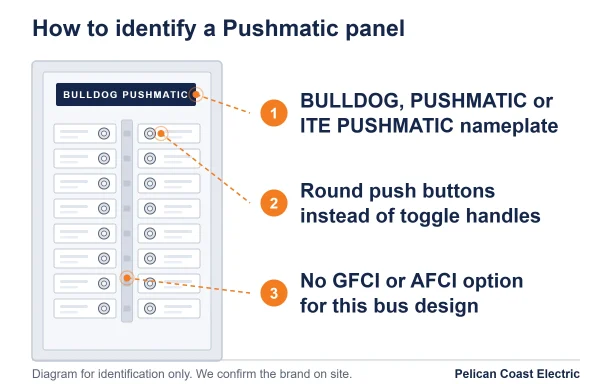
These panels predate arc-fault and ground-fault requirements. Nobody manufactures AFCI or GFCI breakers for these bus designs, so every added circuit inherits 1960s protection.

Most surviving Zinsco and Pushmatic services run 60 to 100 amps. A home with a heat pump, an induction range and an EV charger needs 200. Adding a subpanel to an obsolete main does not solve this and usually fails inspection.
Panel brand tracks build era, and build era tracks neighborhood. Knowing roughly when your house went up tells you what to expect behind the panel door.
Two patterns sit outside the eras below. Homes built before 1960 often carry Pushmatic or Bulldog panels at 50 or 60 amps, usually alongside other findings such as knob and tube wiring or ungrounded outlets. And remodeled homes of any era frequently have a modern subpanel fed by an obsolete main. The subpanel looks current. The main is what the inspection flags.

Zinsco territory. Zinsco was a Los Angeles manufacturer with heavy Southern California distribution, so the concentration here runs higher than most of the country. Older sections of Costa Mesa, Santa Ana, Anaheim and the Balboa Peninsula sit in this window, often at 60 or 100 amps.

Federal Pacific Stab-Lok dominates this stretch. Tract development across Mission Viejo, Huntington Beach, Tustin and much of the postwar expansion used FPE heavily. Most are 100 amp services carrying a mix of original and later-added circuits.

Challenger appears here, along with early Inland Empire growth in Ontario, Rancho Cucamonga and Chino. Service sizes improve to 125 or 150 amps, so capacity drives the job less often. Parts availability still does.

A lot of what gets written about these brands online is wrong. Below is what is documented, what is disputed, and what it means for your house. If an electrician tells you your panel was recalled, ask which recall. None of these four panel lines has ever been recalled.

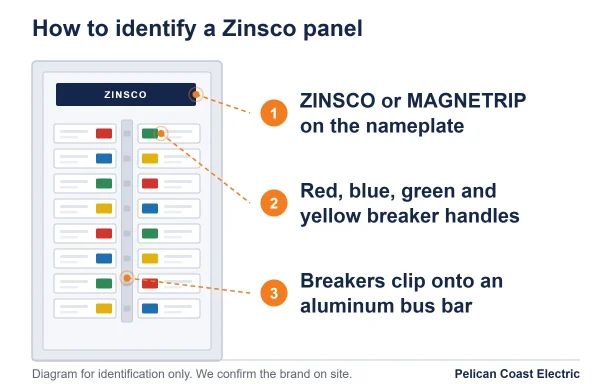
Look for a Zinsco or Magnetrip nameplate on the panel door, or Sylvania on a panel with colored breaker handles in red, blue, green and yellow. Zinsco was a Los Angeles company. It sold to GTE-Sylvania in 1973 and the design was retired after that, so these panels cluster in California homes built between the 1950s and the early 1970s.

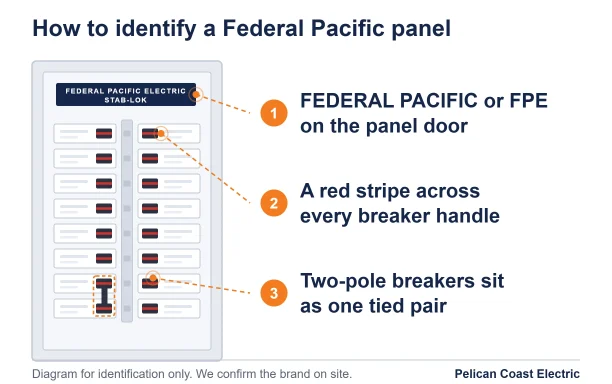
The panel door reads Federal Pacific Electric or FPE. Breakers carry a small red stripe on the handle and the Stab-Lok name. These were installed widely between roughly 1950 and 1980, and they are the most litigated panel in the country.

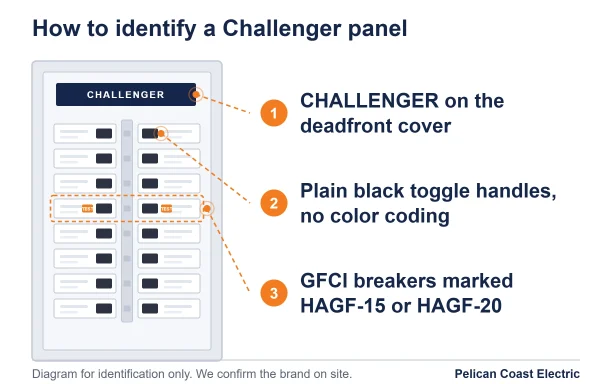
Look for a Challenger nameplate on the deadfront. These turn up in homes built through the 1980s and into the early 1990s, including a lot of early Inland Empire tract housing.

Push buttons instead of toggle handles. The nameplate reads Bulldog, Pushmatic, or ITE Pushmatic. Mostly 1950s and 1960s installations. This is the brand where we part company with a lot of the marketing you will read elsewhere.
From the first look inside the panel to the signed permit, we handle the parts that slow most homeowners down.

On-Site Evaluation
We open the panel, confirm the brand and model, check the service entrance conductors, meter and grounding, and size the new service against how you use the house. You get a written estimate before anything is scheduled, at no charge. If you need documentation for a carrier or a buyer first, our electrical inspection service produces a written evaluation of the existing equipment.

Permit and Utility Coordination
We pull the electrical permit with your city or county jurisdiction and schedule the service disconnect with Southern California Edison. Coordination sets the timeline, not the labor.

Replacement
We remove the old panel and breakers, install a modern service panel with copper bus and current breaker protection, correct grounding and bonding to current NEC, add AFCI and GFCI protection where code requires it, and label every circuit.

Inspection and Sign-Off
The jurisdiction inspects the work. We meet the inspector, handle any corrections, and give you the signed permit and paid invoice, the documentation your insurance carrier asks for.
⚡ Typical timeline: one to two days on site, with power off for part of one day. Permit approval and utility scheduling usually add several business days ahead of that.
Straight answers on the four brands, the recall myths, and what replacement actually involves.
No. Neither brand has been recalled, and neither has Pushmatic. The only related CPSC action is a 1988 replacement program covering roughly 9,000 Challenger GFCI breakers, types HAGF-15 and HAGF-20. It did not cover panels. If someone tells you your panel was recalled, they are repeating something they read online.
Open the outer door and read the nameplate on the panel face or the inside of the door. Zinsco panels say Zinsco or Magnetrip. Federal Pacific says FPE or Federal Pacific Electric, with red-striped breaker handles. Pushmatic uses push buttons instead of toggles. Challenger is printed on the deadfront. If the label is gone or painted over, send us a photo and we will identify it.
There is no repair path worth taking on these brands. You cannot buy original replacement breakers, you cannot add arc-fault or ground-fault protection, and the bus itself is the component with the service history. Replacing individual breakers with salvage parts puts uncalibrated equipment of unknown age into the panel.
California carriers have been non-renewing and declining policies over these brands, and HOAs report the same pressure. Carriers generally want permits, paid invoices and warranty paperwork as proof of replacement. We provide all three. Talk to your carrier about your specific policy.
Most single-family replacements are completed in one day on site, with power off for part of that day. Permit approval and utility scheduling usually add several business days before the work date.
Cost depends on service size, whether the service entrance conductors and meter socket need replacement, panel location, and your jurisdiction’s permit fees. A relocation or a mast replacement raises the number. We give you a written estimate after the on-site evaluation, at no charge.
Connecticut Electric builds new breakers for these bus designs and they are ETL listed to UL 489, which is a legitimate safety listing. They keep a panel running. They do not solve capacity, they do not add arc-fault or ground-fault protection, and they do not resolve an insurance carrier’s objection to the panel.
Condition and brand are separate questions. A panel with no visible scorching still has no parts supply, no arc-fault or ground-fault option, and in most cases not enough capacity for how you use the house now. Those three facts do not improve with time. The evaluation is free, so you get a real answer either way.
Usually no. A panel replacement terminates the existing branch circuits into new breakers. If the evaluation finds aluminum branch wiring, knob and tube, or damaged conductors, we tell you before we quote the job rather than after we open the wall.
Yes. We work throughout Orange County from our Newport Beach office and across San Bernardino County, including Upland, Rancho Cucamonga, Ontario, Claremont, Montclair, Chino and Chino Hills.
Most Orange County homeowners do not go looking for information on their panel brand. An insurance carrier finds it first, or a buyer’s inspector does. Both outcomes land on you as a deadline.

California admitted carriers have been non-renewing and declining policies over these brands. Homeowners and HOAs report the same pressure. Properties that do not comply get pushed into the excess and surplus market at higher premiums.

A California home inspector is not permitted to declare a panel defective by brand. What an inspector does is note the equipment and recommend evaluation by a licensed electrician. That line lands in the report and becomes a repair request or a credit at closing.

Carriers want permits, paid invoices and warranty documentation, not a photo of a new panel. We provide all three, and we hand them to you at sign-off.

Licensed electricians working from our Newport Beach office across Orange County and San Bernardino County.


Real reviews from homeowners across Orange County.
Send us a photo of your panel label or book a free on-site evaluation. We will tell you what brand you have, what the replacement involves, and what it costs, in writing.
Get a personalized quote for your Zinsco, Federal Pacific, Challenger or Pushmatic panel replacement